



Most screen-time advice fails because it starts too late.
By the time someone is already scrolling, watching, tapping, or checking one more thing, the habit has momentum. The room has already voted.
The two-minute paper reset is built for that exact moment.
It does not ask a family to become anti-tech. It does not ask an adult to build a perfect morning routine. It does not ask a grandparent, parent, teacher, or caregiver to become the screen police.
It asks for one small move before the next screen.
The rule is simple enough to spread.
Before the next entertainment screen, do two minutes on paper.
Circle five words. Color one small section. Solve one Sudoku row. Trace one maze path. Write one clue. Put one pencil mark on one page.
That is the whole entry point.
The reset has three parts.
One pencil.
One visible page.
Two minutes before the next screen.
The point is not to replace every device. The point is to stop the device from becoming the automatic first move.
That distinction matters.
People rarely need another lecture about screen time. They need a lower-friction alternative sitting in the path of the habit.
A paper page can do that because it is physical, finite, and obvious. It does not need a login. It does not autoplay. It does not open another tab. It gives the hand a job and the mind a narrow track.
Why this idea travels
The best household rules are short enough to remember while tired.
Two minutes on paper before the next screen passes that test.
It is visual. It is repeatable. It fits a kitchen table, nightstand, desk, backpack, waiting room, porch chair, or grandparent visit.
It also avoids the trap that kills most screen-free plans: making the replacement too vague.
No screens right now creates a vacuum.
Two minutes on this page creates a next action.
That is why a small puzzle page can outperform a big speech.
Why the Pencil Interrupts the Loop
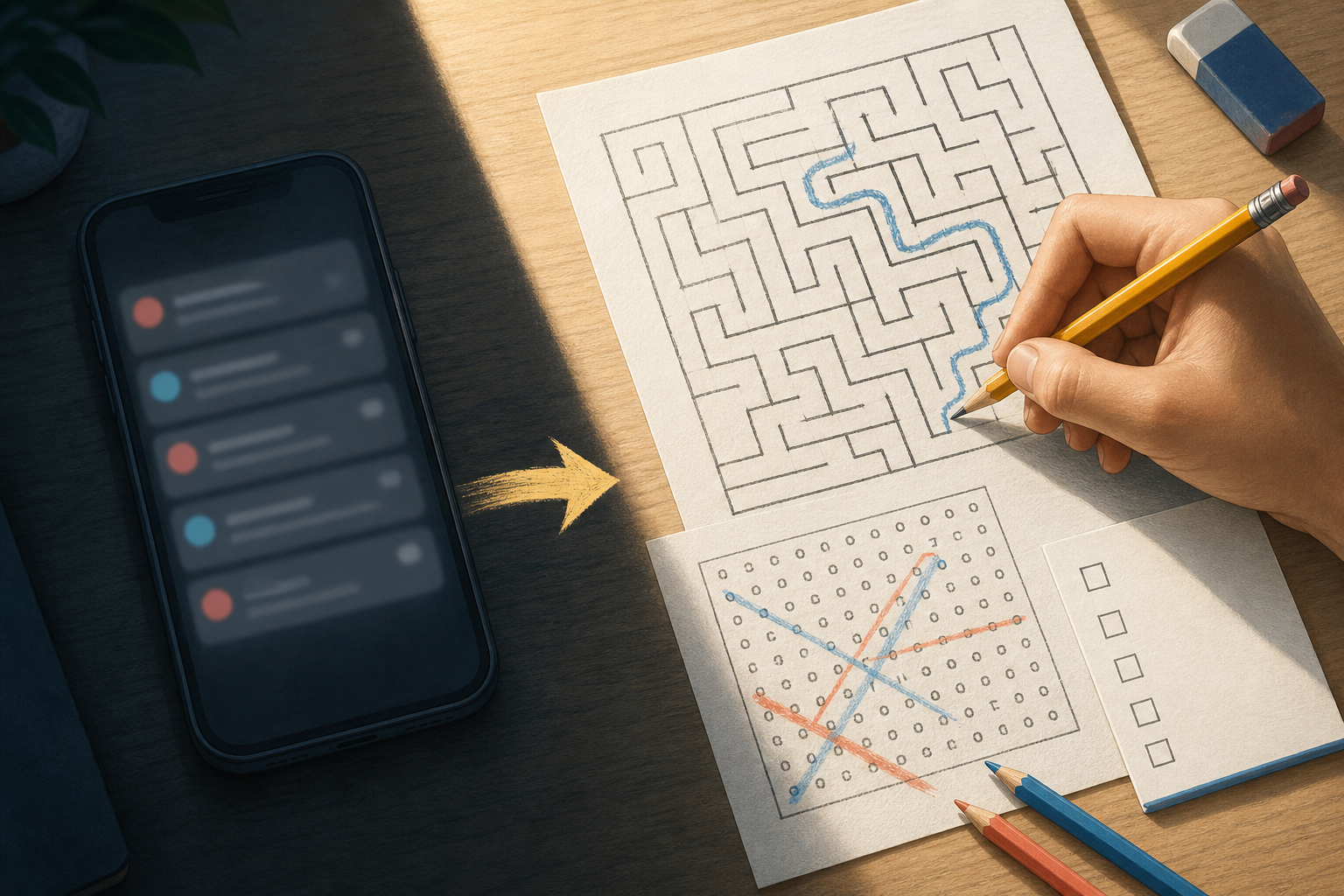
A phone is built to keep the next tap nearby. Notifications, autoplay, infinite feeds, and app badges all make the next move feel effortless.
Paper changes the sensory script.
You pick up a pencil. You look at a single page. You make a mark. The result is visible. The session has an edge.
The American Academy of Pediatrics pushes families toward media plans, screen-free zones, and habits that fit the whole household instead of only chasing raw screen-minute math.
Pew Research Center reported in 2025 that 42% of U.S. parents said they could be doing better at managing their child's screen time. That number is useful because it reveals the real audience: not negligent parents, but overloaded households trying to make the default easier to beat.
The two-minute reset turns that pressure into a table-level action.
What counts as a reset
The reset should be almost embarrassingly easy.
A preschooler can color one flower.
A grade-schooler can circle five hidden words.
A teen can solve one Sudoku row.
An adult can do one mini crossword clue or one logic step.
A grandparent can finish a large-print word search line.
The format matters less than the visible start.
If two minutes becomes twelve, good. If two minutes stays two, still good. The win is that the screen did not get the first unchallenged move.
Set the Table Before the Screen Wins
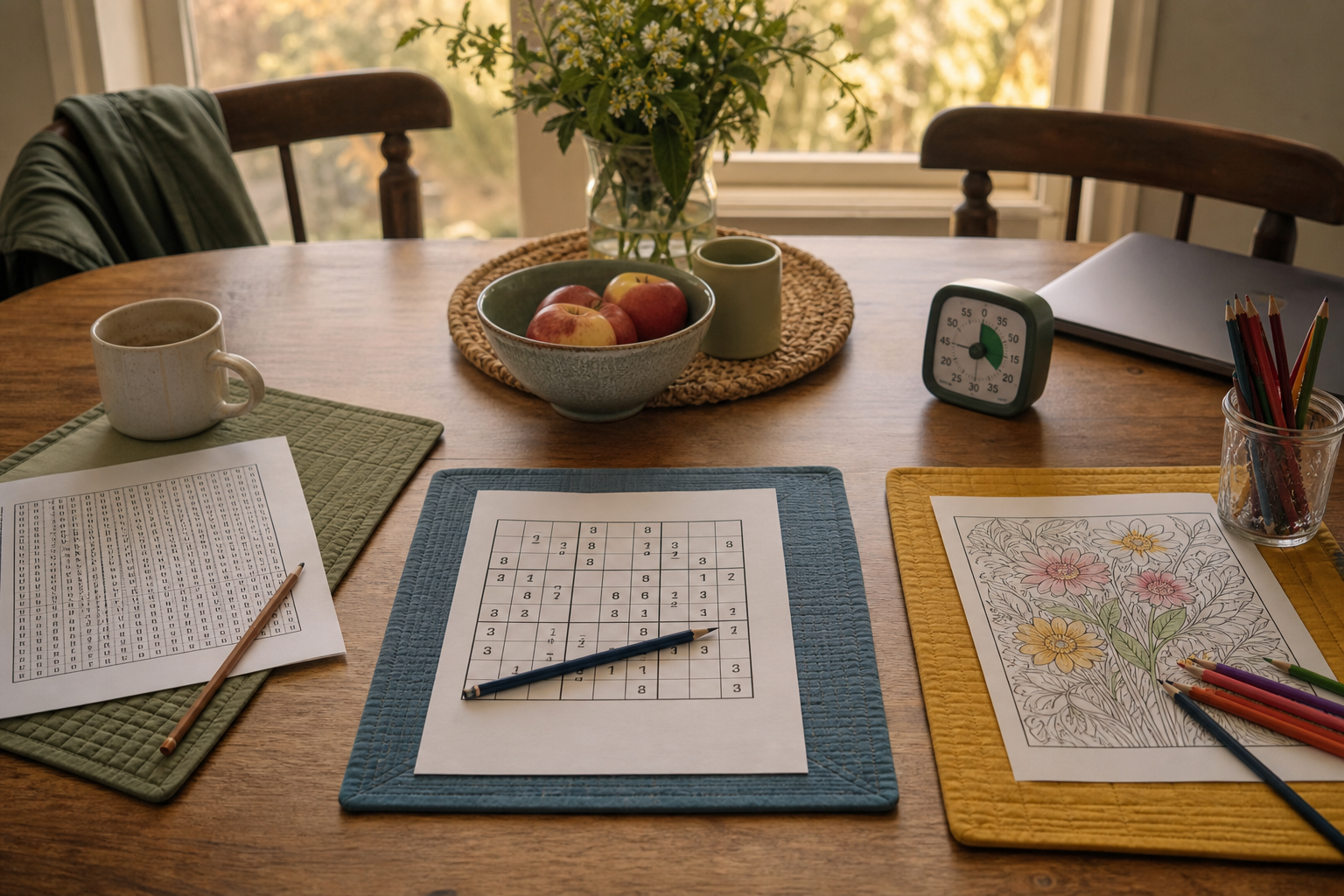
The reset only works if the page is easier to reach than the device habit.
Put the paper where the scrolling usually begins.
Kitchen table.
Couch side table.
Bedside table.
Desk corner.
Car organizer.
Grandparent activity basket.
Waiting room tote.
Do not hide the puzzle books on a shelf and expect motivation to do the work.
The page has to be visible before the argument begins.
The best starter kit
Use three page types so nobody has to agree on the same mood.
One easy coloring page.
One word search page.
One number or logic page.
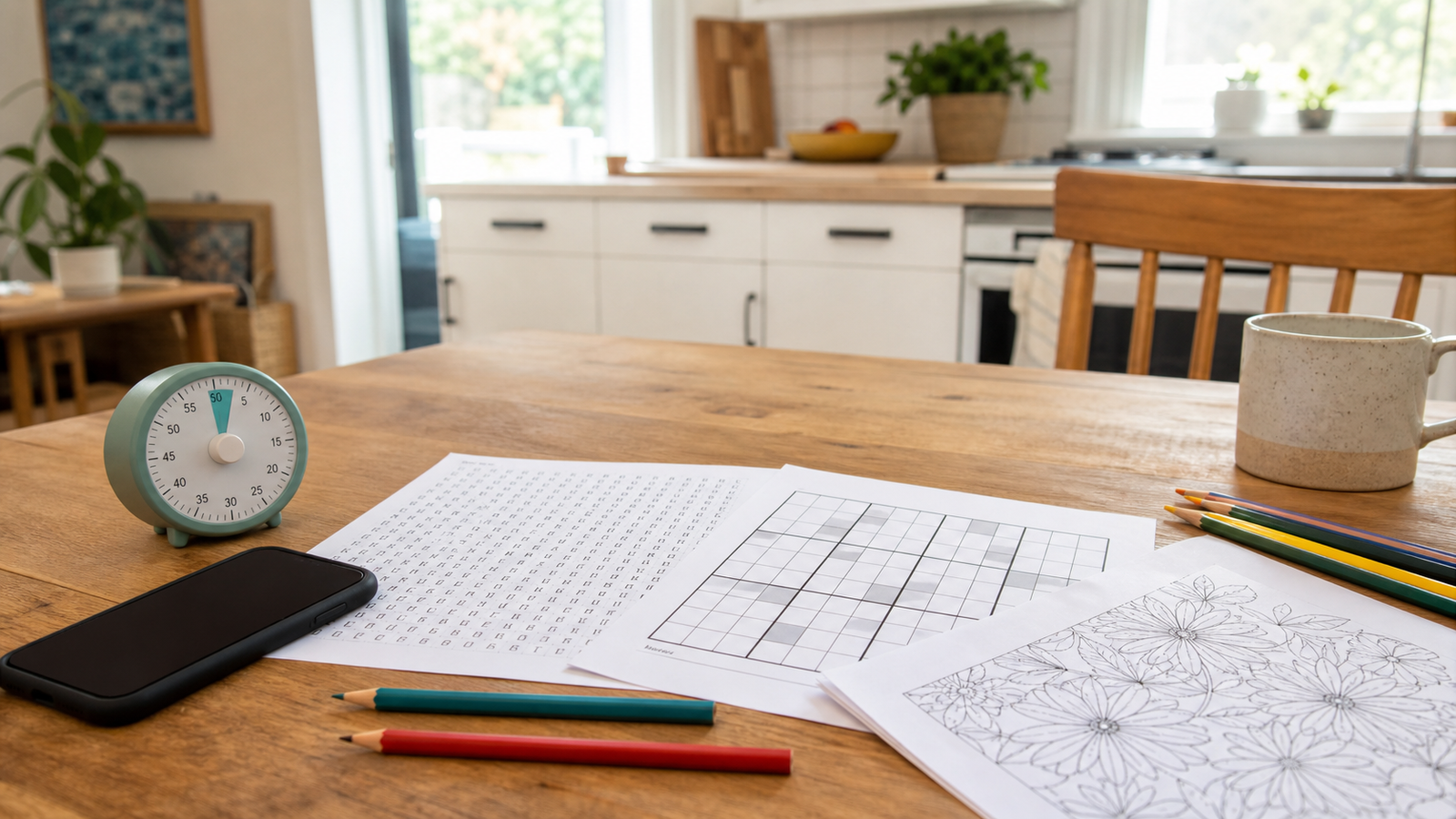
Add a pencil, an eraser, and a small timer.
That mix gives the household range without turning the reset into a shopping project. Coloring works when the brain wants low-pressure motion. Word search works when the reader wants a hunt. Sudoku or a logic puzzle works when the mind wants structure.
For seniors or tired eyes, use large-print pages. The point is the puzzle, not squinting.
What not to do
Do not make the first page hard.
Do not make the reset a punishment.
Do not turn two minutes into a moral lecture.
Do not require everyone to finish a full page.
Do not keep the supplies in a cabinet.
Do not start by buying the most advanced puzzle book in the house.
If the first step feels like homework, the screen wins.
The script that works
Use one line and repeat it calmly.
Two minutes on paper, then we choose.
That line works for kids because it is concrete. It works for adults because it does not sound like a productivity cult. It works for grandparents because the activity is familiar and portable.
The word then matters.
The reset is not framed as a forever ban. It is framed as sequence control.
Paper first. Screen second.
Why handwriting and marking matter
There is a reason a pencil feels different from a tap.
Research on handwriting and learning has found meaningful differences between handwriting and keyboarding, especially around the motor and attention demands of forming marks by hand. That does not mean every paper activity is magic. It does mean that pencil-on-page work asks the body and brain to participate differently than passive scrolling.
That is the practical value here.
A puzzle page gives attention something specific to do.
Find the word.
Fill the square.
Choose the color.
Trace the path.
Make the mark.
For a screen reset, that is enough.
The seven-day version
Run the reset for one week.
Day one: two minutes of coloring.
Day two: two minutes of word search.
Day three: two minutes of Sudoku or number puzzles.
Day four: two minutes of mazes.
Day five: two minutes of large-print puzzles with a parent or grandparent.
Day six: two minutes outside or near a window.
Day seven: let everyone choose the page.
Do not track perfection. Track starts.
The metric is not how long everyone stayed off a screen. The metric is whether the household learned a new first move.
Where PuzzlePlayBooks fits
Puzzle books are useful here because they remove setup friction.
A good basket can hold a kids coloring book, an adult coloring book, a word search book, a Sudoku book, and a large-print option for seniors or grandparents.
That gives the room a fast answer for different ages, moods, and attention levels.
The best book is the one that gets opened before the screen habit takes the room.
The takeaway
The two-minute paper reset is not anti-screen.
It is anti-autopilot.
Screens can teach, connect, entertain, and help. They should not win every idle minute just because the first tap is easy.
Put a pencil where the habit starts.
Put one page beside it.
Run two minutes.
Then choose what comes next.
Sources and Further Reading
- American Academy of Pediatrics Family Media Plan
- American Academy of Pediatrics on making a family media plan
- Pew Research Center on how parents approach kids' screen time
- World Health Organization guidelines on physical activity, sedentary behaviour and sleep for children under 5
- Frontiers in Psychology on handwriting and brain connectivity
- NIH-indexed review on handwriting versus typing