

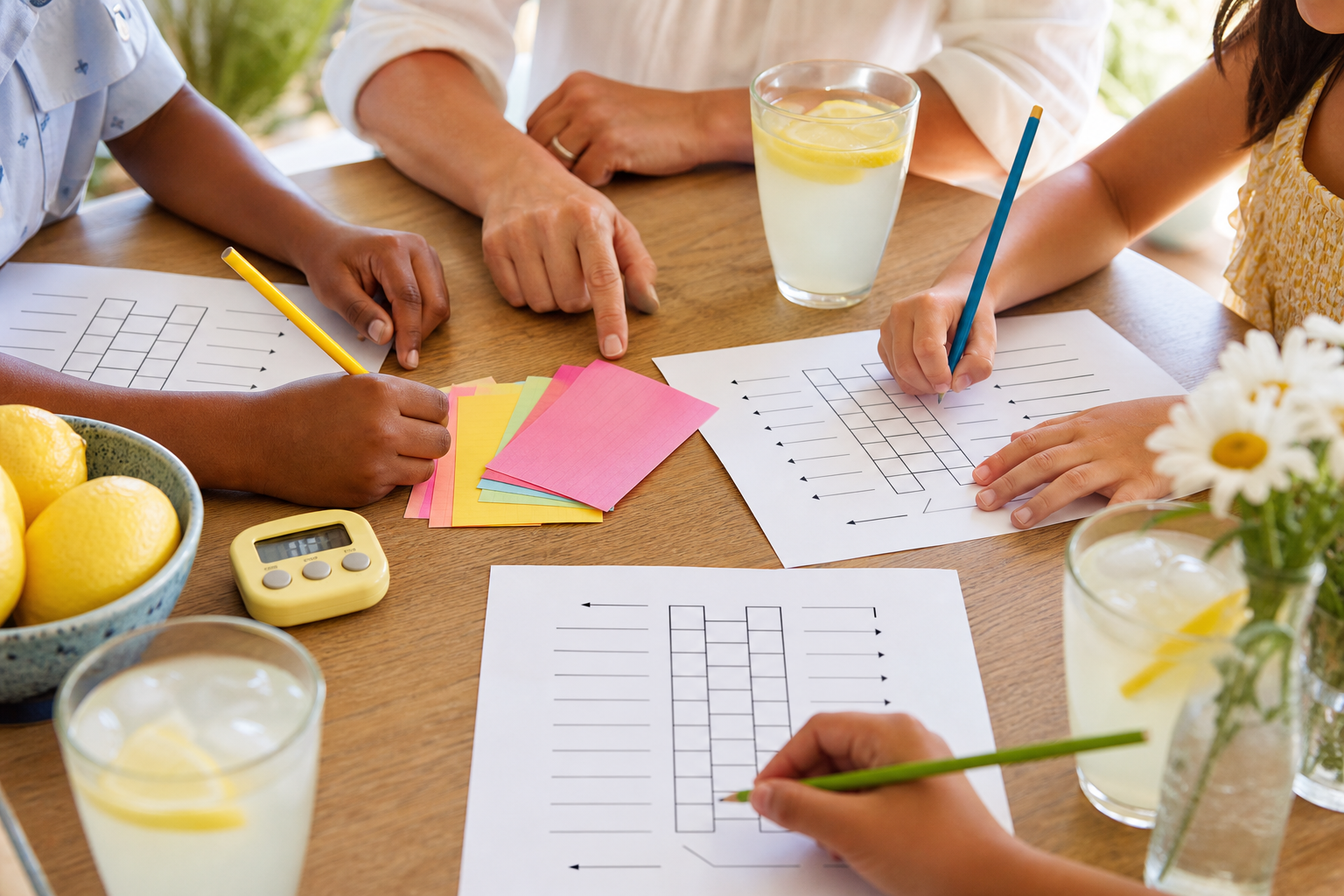


Daily word games and quick brain teasers keep showing up because they offer something rare: a small win that fits into a busy day. A printable word ladder race borrows that same appeal, then makes it social enough for classrooms, camp tables, road trips, and family game night.
The rules are simple. Start with one word, change one letter at a time, and land on the target word. Every step must make a real word. Add a timer, split players into teams, and the activity becomes a ten-minute challenge that feels more like a game than another worksheet.
Why Word Ladders Are Shareable Right Now
Current puzzle interest is not limited to one app or one newspaper grid. Google News results this week surfaced daily word-game coverage, standalone brain teasers, and educator-focused summer learning ideas. That mix matters for Puzzle Playbooks readers because it points to a format people already understand: short, repeatable, pencil-friendly challenges that can be played alone or with a group.
Word ladders fit that moment. They are quick to explain, easy to print, and flexible across ages. Younger players practice spelling and vocabulary. Older players practice constraint thinking: each move has to satisfy the word rule and still move toward the target. Adults get the satisfying feeling of a tiny logic puzzle without needing a long rulebook.
The 10-Minute Word Ladder Race Format
Use this when you need a fast activity that does not require screens, accounts, batteries, or a table full of pieces. The host prints one race sheet per player or team, sets a ten-minute timer, and awards points for completed ladders, clever legal paths, and clean teamwork.
The best version has three short ladders on one page. One ladder should be easy, one should be medium, and one should be the bonus challenge. Players can solve in any order, which keeps faster solvers engaged without making newer solvers feel stuck on the first clue.
Example Race Sheet
Easy ladder: CAT to DOG in four moves. One possible path is CAT, COT, DOT, DOG. Medium ladder: COLD to WARM in five to seven moves. Bonus ladder: GAME to NIGHT using only common words. The bonus does not need to have a single perfect route; the fun is in comparing paths after time is called.
Scoring Rule
Give five points for each completed easy or medium ladder, ten points for the bonus ladder, and one extra point for every unused minute if all three are finished. If teams are mixed by age, add a teamwork point when an older player explains a clue without giving away the answer.
Printable Setup: One Page, Three Ladders, Ten Minutes
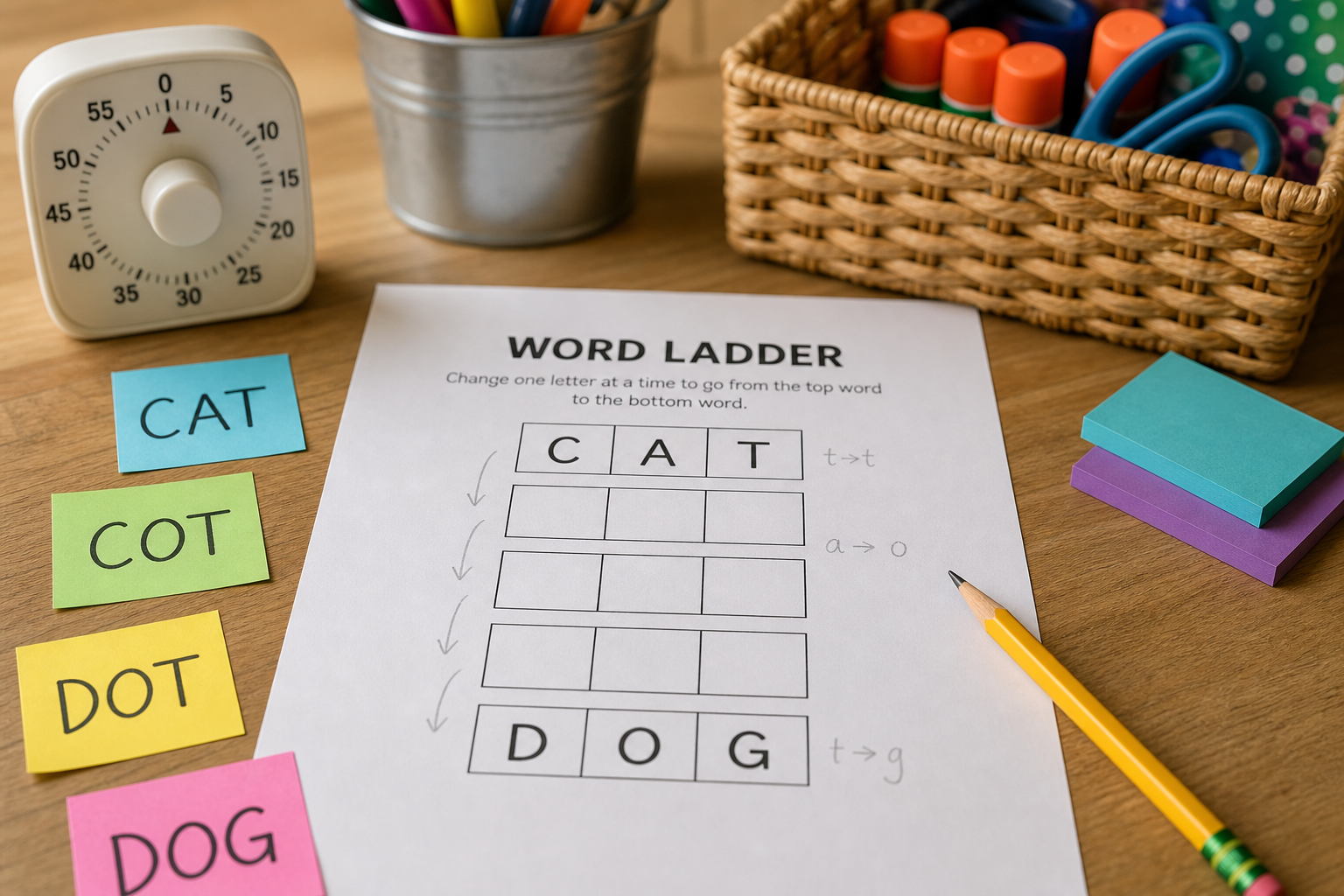
A strong printable page has four parts: the start word, the target word, blank boxes for each step, and a tiny rule reminder. Keep the design clean. Big boxes work better than cramped lines because players will erase, rethink, and argue for better routes.
For younger players, use three-letter words and allow a host-approved word list nearby. Good starter pairs include CAT to DOG, SUN to FUN, MAP to CAP, HAT to HOT, and BIG to BAD. For older players, move to four-letter words such as COLD to WARM, SAND to WAVE, BOOK to READ, or GAME to PLAY.
Host Materials
Print one race sheet per team, one answer guide for the host, and one blank ladder builder page for early finishers. Add pencils, erasers, and a visible timer. If the activity is for a classroom or camp, put each team sheet in a folder so the table looks organized before players arrive.
Difficulty Control
Difficulty changes quickly when the words get longer. A three-letter ladder is usually a warmup. A four-letter ladder can become a serious logic puzzle. A five-letter ladder should be reserved for teens, adults, or a bonus round where hints are allowed.
How to Build Better Word Ladders
Start by choosing a pair with emotional or seasonal contrast: COLD to WARM, RAIN to SUN, CAMP to GAME, WORK to PLAY, or HOME to ROAD. Then test the path yourself before printing. If you cannot solve it in a few minutes, it is probably too hard for a timed group activity.
Use common words, not obscure dictionary saves. The goal is a satisfying solve, not a spelling argument. Avoid proper nouns, brand names, abbreviations, and words that depend on regional spelling. For kids, avoid words that sound alike but are spelled differently unless the activity is explicitly about homophones.
Hint Ladder Method
When a group gets stuck, do not give the next word immediately. Give a constraint hint instead: change the vowel first, turn the beginning sound into a new word, or aim for a word that rhymes with the target. Hints should preserve the aha moment.
Replay Twist
After the first race, ask teams to build one ladder for another team. The creator has to prove that the ladder is solvable before trading. This turns players into puzzle designers and usually produces louder, better discussion than a second worksheet would.
Make It Work for Family Night, Camps, and Classrooms

For family night, run the race as adults versus kids for the first round, then mixed teams for the second. Mixed teams are usually better because adults slow down enough to explain strategy, while kids often spot simple word jumps adults overlook.
For classrooms, use word ladders as a bell-ringer, literacy center, early-finisher option, or Friday team challenge. Put the rule on the board: change one letter, keep every step a real word, and be ready to defend your path. That last phrase matters because it turns the puzzle into vocabulary talk.
For summer camps and libraries, laminate a few reusable sheets or slide printed pages into dry-erase sleeves. Add a scoreboard only if it increases energy without embarrassing slower solvers. In most groups, team completion and funny path reveals are enough.
Quiet Version
Use individual sheets, a five-minute timer, and silent solving. At the end, players circle their favorite move and explain it to a partner. This version works well for morning warmups, tutoring sessions, and kids who dislike loud races.
Party Version
Place three ladder stations around the room. Teams rotate every three minutes and can only write two moves before passing the sheet. The constraint creates a relay feel and prevents one strong solver from taking over the whole game.
A Ready-to-Print Mini Set
Here is a starter set you can copy onto one page. Warmup: CAT to DOG, four boxes. Easy: SUN to FUN, three boxes. Medium: COLD to WARM, six boxes. Bonus: GAME to PLAY, six boxes. Builder challenge: create a summer-themed ladder from CAMP to FUN.
Add one answer key note: paths may vary. That phrase prevents the common mistake of treating a word ladder like a single-answer worksheet. If every step is a real word and changes only one letter, the answer can be valid even when it is not the host path.
Common Mistakes to Avoid
Do not make every ladder a race. Timers add energy, but they can also flatten the best part of a word puzzle: exploring possible routes. Use one timed round, then one builder or discussion round.
Do not overdecorate the printable page. A clean page with enough writing room is more valuable than a crowded page with cute margins. If the game is for younger kids, spend the design space on bigger boxes and clearer rules.
Do not make the first puzzle too hard. A fast first win is what gets people to keep playing. Save the difficult ladder for the bonus round, the adult table, or the team that asks for more.
More Word Games to Try
Pair this activity with the Road Trip Puzzle Kit for travel days, the Printable Puzzle Relay for team events, the Mini Paper Escape Rooms guide for party hosts, and the Summer Brain Camp station plan for educators building a longer screen-free block.
Start With a One-Page Puzzle Night
If you want more printable activities like this, start with a one-page puzzle night: choose one word ladder, one word search, and one logic puzzle, then set a twenty-minute screen-free timer. Puzzle Playbooks is built for exactly that kind of low-prep, pencil-first play.