



A sunflower puzzle pack works well right now because it gives families, teachers, librarians, and activity buyers one bright late-summer theme that still feels easy to print and easy to reuse. The National Sunflower Association notes that the wild sunflower is native to North America, the National Park Service says more than 75 percent of the Earth's flowering plants depend on pollinators, and the U.S. Forest Service notes that more than half of the world's diet of fats and oils comes from animal-pollinated plants including sunflowers. That gives adults a real seasonal theme without turning a short puzzle packet into a heavy lesson.
The timing also fits the kinds of activity windows adults are juggling in late summer. Some families want one cheerful folder for kitchen-table quiet time, car rides, and vacation-rental downtime. Some teachers want a nature-friendly page set for welcome-week bins, library corners, or indoor recess backup. Some librarians and homeschool planners want a printable theme that feels friendly across mixed ages. Sunflowers are specific enough to feel memorable and broad enough to support mazes, matching pages, tally sheets, codes, and short writing prompts.
That is why this kind of printable works. It gives kids a visible puzzle to notice and finish, helps adults skip one more automatic screen handoff, and makes it easier to build a short nature-theme activity block without needing scissors, glue, or a big prep session.
One important note first: these pages work best during seated, supervised activity windows such as kitchen tables, library tables, classroom centers, garden-club bins, travel folders, and rainy-afternoon resets. They are not for use while children need full attention on walking through parking lots, crowded paths, exhibits, or active outdoor spaces.
Why a sunflower puzzle pack works
Sunflowers are easy to recognize, easy to draw into puzzle formats, and easy to pair with words that younger and older solvers can both use. The theme also naturally supports observation, sorting, counting, route finding, and pattern work without requiring specialized background knowledge before anyone starts.
Printables help most in moments like these:
• while a family wants one nature-theme page that feels more cheerful than a generic worksheet.
• while a teacher needs a late-summer printable for a classroom soft start, early finisher bin, or short welcome-week station.
• while a librarian, camp leader, or homeschool parent wants a table activity that works across mixed ages.
• while an activity buyer wants one folder that can travel from a garden visit to a kitchen-table reset without much explanation.
• while siblings need the same table mood without the exact same difficulty level.
That is also why the packet should stay practical. Good sunflower pages should feel inviting at first glance, print clearly in black and white, and still make sense if a child pauses halfway through and comes back later.
What makes a good sunflower-themed printable
The strongest page uses the theme as a guide instead of treating it like decoration. A sunflower icon, seed pattern, petal shape, or garden word should make the task feel clear right away, but the puzzle still has to work even if the solver only looks at it for a few seconds before beginning.
Aim for:
• one clear task per page, such as search, sort, decode, tally, match, maze, or finish the pattern.
• broad words and visuals that still work at home, in classrooms, at libraries, or on travel days.
• answer spaces large enough for clipboards, counters, classroom desks, and family trays.
• pages that survive interruption, so solvers can stop and restart without losing the thread.
• directions short enough that another adult can hand over the page without reteaching the whole packet.
• a mix of quick visual wins and one or two stronger logic or word pages for older solvers.
If a printable depends on one exact garden map, one exact field-trip stop, or a long science lecture before the first answer, it is probably the wrong kind of family-ready sunflower pack.
The 15 printable sunflower games worth building first
1. Sunflower-word search
Hide approachable words such as petal, stem, seed, yellow, field, bloom, bee, and leaf. This gives mixed ages a fast first win and sets the theme immediately.
2. Petal-count compare card
Show a few simple flower shapes and ask solvers to circle which one has more petals or fewer petals. Keep the page visual so younger kids can join without much reading.
3. Seed-path maze
Create a short route from garden gate to sunflower patch without crossing blocked squares, puddles, or fence lines. Compact mazes work better than giant ones when time is short.
4. Bee-or-butterfly sort
Use broad picture or word prompts and ask players to sort what belongs with bee clues, butterfly clues, or both. This keeps the theme tied to pollinators without making the page feel dense.
5. Petal-pattern strip
Alternate petals, leaves, seeds, and raindrops in a simple pattern, then add a harder row underneath for older solvers who want more challenge.
6. A=1 bloom codebreaker
Use a simple number key to reveal words such as SEED, BLOOM, STEM, HONEY, or FIELD. This adds challenge without adding supplies.
7. Tall-or-small garden compare page
Show silhouettes such as sunflower, watering can, bee, boots, and fence post, then ask players to compare height or size. This is easy to explain and works well on library tables.
8. Sunflower tally sheet
Scatter icons such as petals, leaves, bees, watering cans, and seed packets around the page. Ask solvers to count, compare, and answer one extra question about which symbol appeared most often.
9. Shade-and-sun direction grid
Use left, right, up, and down arrows to guide a pencil from the shade tree to the sunflower row. Older solvers often enjoy the small map feel of this kind of page.
10. Shadow match sheet
Match a few simple sunflower heads, leaves, and garden tools to the correct outline. This gives younger solvers a quick visual page that still feels on-theme.
11. One-letter garden word ladder
Build a short ladder such as SEED to NEED or BEE to SEE with one-letter changes. Older readers often like this because it feels more like a puzzle than a worksheet.
12. Mini sunflower logic puzzle
Use three kids, three puzzle pages, and three garden jobs with a few clues. Keep it short enough to solve in under three minutes so it stays satisfying instead of heavy.
13. Spot-the-difference garden scene
Show two simple sunflower scenes with a few changed details, such as one missing leaf, one extra bee, or one swapped watering can. This works across reading levels.
14. Notice-and-write prompt
Give players three short lines to name one garden detail they noticed, one page they liked, and one nature theme they would add next time. This keeps the packet from becoming only grids and codes.
15. Final BLOOM password page
Let answers from earlier pages reveal one letter each so the packet ends with BLOOM, SEEDS, SUNNY, or GROWTH. A final password gives the folder a clear finish without needing prizes.
Three quick mini examples
These are simple enough to build before the next library table, garden-club station, classroom nature bin, or family quiet block.
Example 1: short riddle
I am bright, tall, and full of seeds, but I am not a tree. What am I? Answer: sunflower.
Example 2: simple code
Use A=1, B=2, C=3. 2 - 12 - 15 - 15 - 13. Answer: BLOOM.
Example 3: easy logic clue
Maya, Theo, and June each picked one page: maze, word search, and codebreaker. Maya did not pick the maze. Theo did not pick the codebreaker. June did not pick the word search. Answer: Maya picked the word search, Theo picked the maze, and June picked the codebreaker.
How to package a sunflower folder
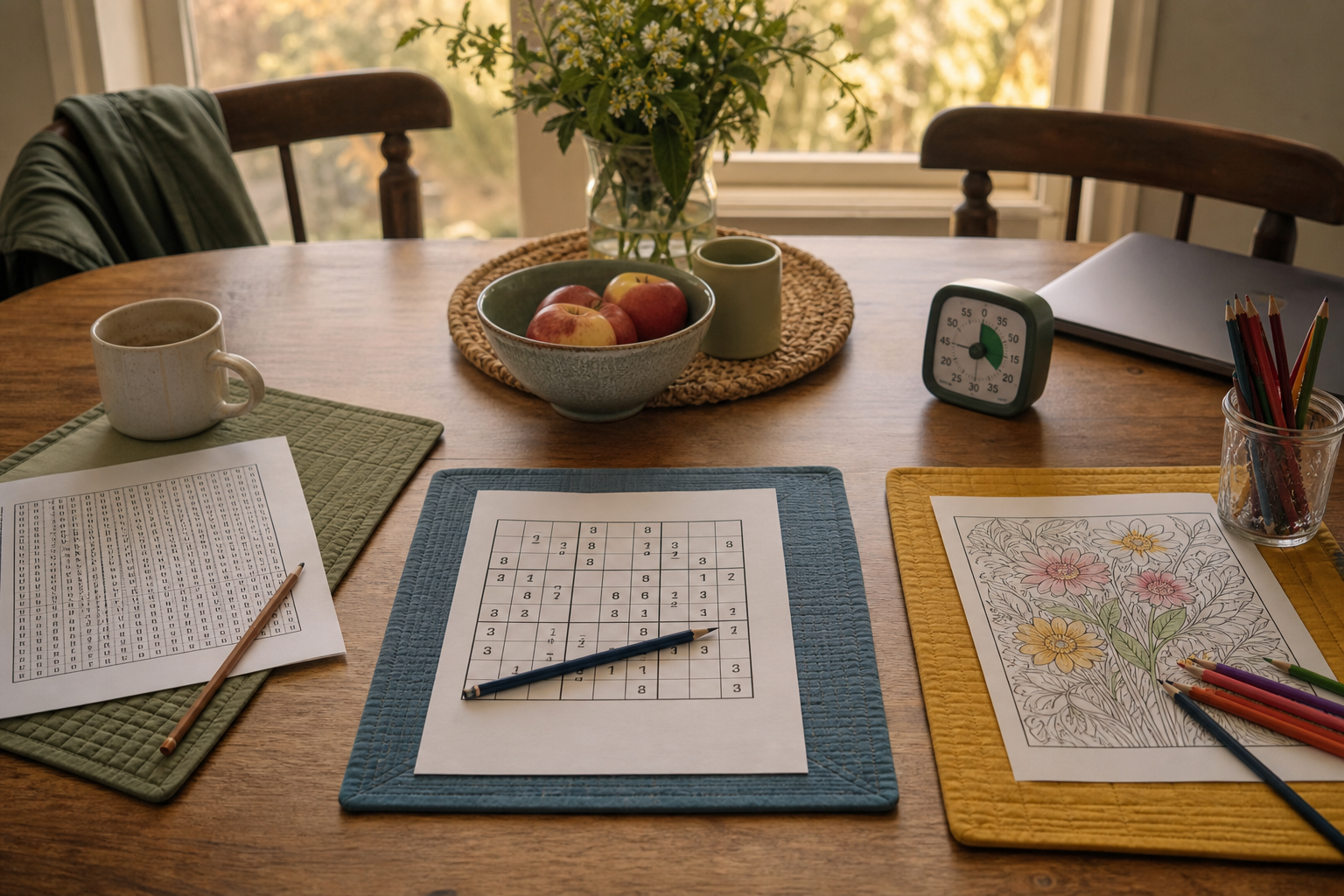
A strong sunflower-theme packet usually needs only six to nine pages.
Start with:
• 2 fast pages such as a word search or tally sheet.
• 2 visual pages such as a maze, shadow match, or pattern strip.
• 2 slightly stronger pages such as a codebreaker or logic mini.
• 1 short writing or notice page.
• 1 final password page.
• 1 answer key.
That mix is enough for a classroom bin, library stack, travel folder, homeschool packet, or kitchen-table reset without making the packet feel bulky.
A short reusable folder also makes it easier to stay intentional about screens. The AAP Family Media Plan is useful here because the same principle applies in real life: when one or two paper pages are already visible, adults do not have to improvise with a device every time the room gets restless or the wait gets longer than expected.
Classroom, library, garden-table, and family version
For teachers, start with the word search, tally page, and shadow match during arrival time, a nature unit, or a welcome-week quiet block. Save the codebreaker, word ladder, and final password for later in the week when students already understand the routine and want a page that feels more complete.
For librarians, camp leaders, and homeschoolers, this theme works well for garden displays, pollinator-theme tables, mixed-age quiet stations, and printable take-home folders. Use the compare card, one visual page, one codebreaker, and the final password as short stations, then keep the answer key nearby so the activity stays self-directed.
For families, keep one easy page for younger kids, one stronger page for an older sibling, and one page that can be colored or finished later at home. The best mixed-age packet gives everyone the same table mood without forcing the same difficulty.
Fast answers to common buyer questions
What ages work best for sunflower printables?
Most packs work best for ages 5 and up, with easier matching, tally, and pattern pages for younger solvers and code, logic, and word-ladder pages for older kids.
What supplies should the packet assume?
Assume only a printer, pencil, and optional crayons or colored pencils. If a page needs scissors, glue, or internet access to function, make that obvious before anyone prints it.
How long should a sunflower puzzle session last?
Five to fifteen minutes is usually enough for a library table, short classroom center, car ride folder, or family quiet block. Shorter sessions are easier to repeat than one long packet marathon.
Do these pages only work for late summer?
No. The same pages can still work for garden themes, pollinator units, homeschool nature weeks, travel folders, and rainy-day backups after summer ends.
Common mistakes to avoid
Do not make every page so hard that younger solvers need constant rescue.
Do not overload the packet with tiny facts and long paragraphs before anyone gets to solve anything.
Do not build the whole theme around one exact garden route, field-trip plan, or seasonal display that other families will never see.
Do not forget the real-world context. Kids may be waiting, transitioning, or sharing a table, so the printable has to survive interruption.
Internal link suggestions
Pair this topic with the Botanical Garden Puzzle Pack, the Farmers Market Puzzle Pack, the National Park Puzzle Pack, the World Elephant Day Puzzle Pack, the Brain Break Puzzle Pack, and the free puzzles and games page. Readers who like this theme often want one more nature, outing, or quiet-table printable for the next mixed-age activity block.
Call to action
Want more printable-style puzzle ideas that work in real family schedules, real classroom transitions, and real mixed-age tables? Browse PuzzlePlay Books for family-friendly puzzle guides, low-prep printables, free games, and practical screen-light activities that are easy to print and easy to reuse.