



The school phone ban is becoming the easy part.
The harder part starts at 3:41 pm, when a kid walks through the door, drops the backpack, and reaches for the screen that school just spent all day keeping away.
This is the next parenting problem hiding inside the phone-free school movement. Schools can lock down the classroom. They can make hallways louder again. They can protect the school day from the constant pull of group chats, short videos, games, and notifications.
But when the final bell rings, the phone-free policy stops at the curb.
That is why families need an after-school plan that is smaller than a detox and stronger than a lecture. The plan is not another rule. It is a better first move.
The Policy Shift Is Real
UNESCO's Global Education Monitoring Report wrote in March 2026 that national school phone bans had spread to 114 education systems, representing 58% of countries worldwide. In the United States, UNESCO reported that 39 states had either statewide bans or regulations requiring districts to restrict classroom phone use.
The same shift is showing up inside schools. A 2026 University of Michigan Ford School report on the Phones in Focus educator survey found that bell-to-bell bans in its national sample rose from 60% of schools in 2024-25 to 74% in 2025-26.
That does not mean every policy is perfect. It does mean the norm is moving. Phones are becoming less welcome during the school day, and more adults are willing to say the quiet part directly: constant access has a cost.
The problem is that a school policy only protects school hours. Kids still come home to the same devices, the same boredom, the same autoplay, and the same frictionless escape hatch.
The After-School Gap
The first hour after school is messy. Kids are tired, hungry, overstimulated, under-stimulated, social, cranky, wired, or all of it at once.
That is exactly why the phone wins. It asks for nothing. It gives instant novelty. It does not require setup, conversation, patience, or a clean table.
A parent can say no screens until homework is done. That may be the right boundary. But a boundary without a replacement often turns into a negotiation loop. The child hears no. The parent starts explaining. The device stays mentally present the whole time.
The better move is to make the first offline activity physically obvious before the argument begins.
The After-School Reset
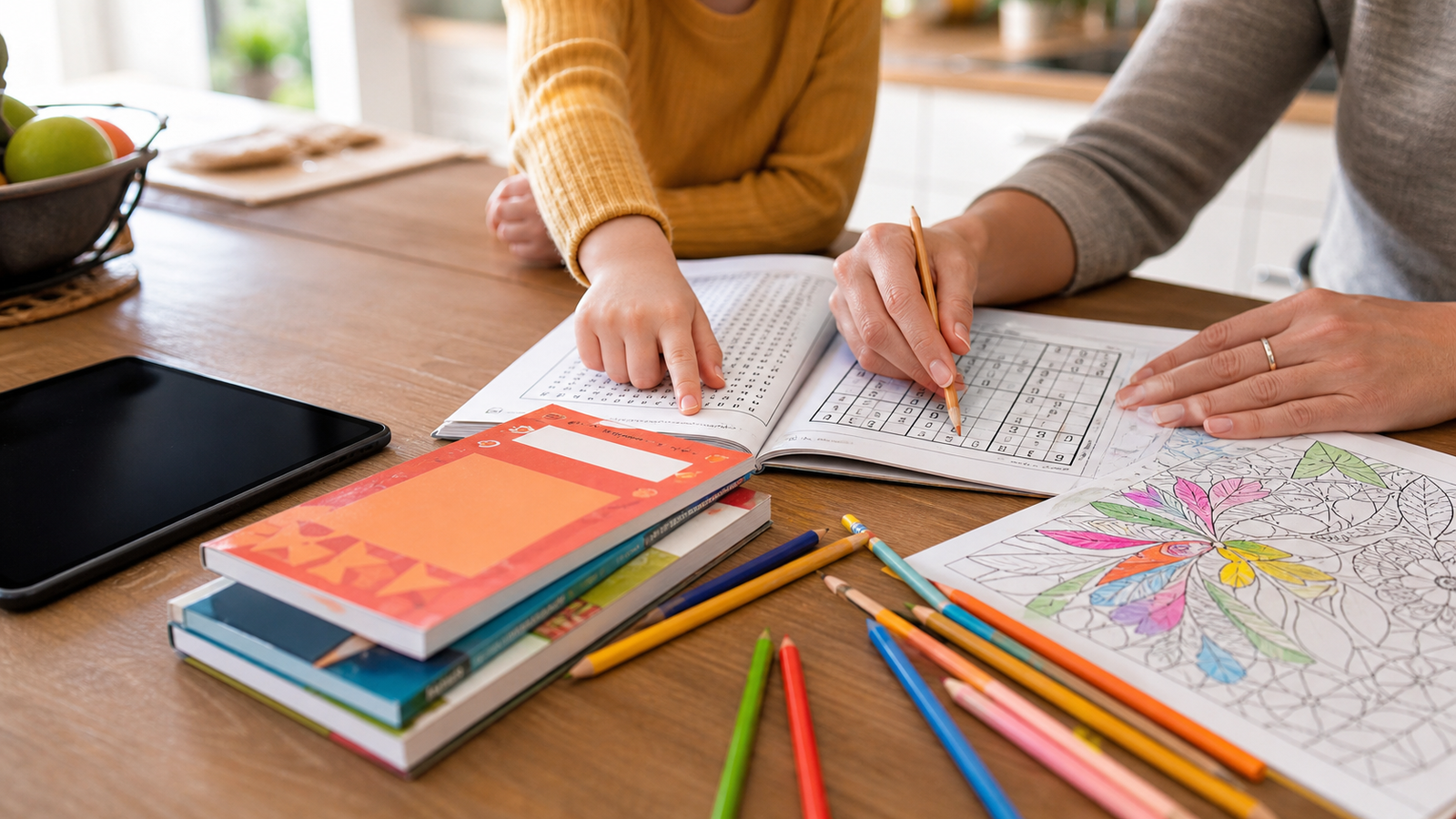
Create a visible paper reset station where the screen habit usually starts.
This can be a basket, tray, shelf, table corner, backpack pouch, or grandparent bag. The container is not the point. The point is that the paper option is already there before the device becomes the default.
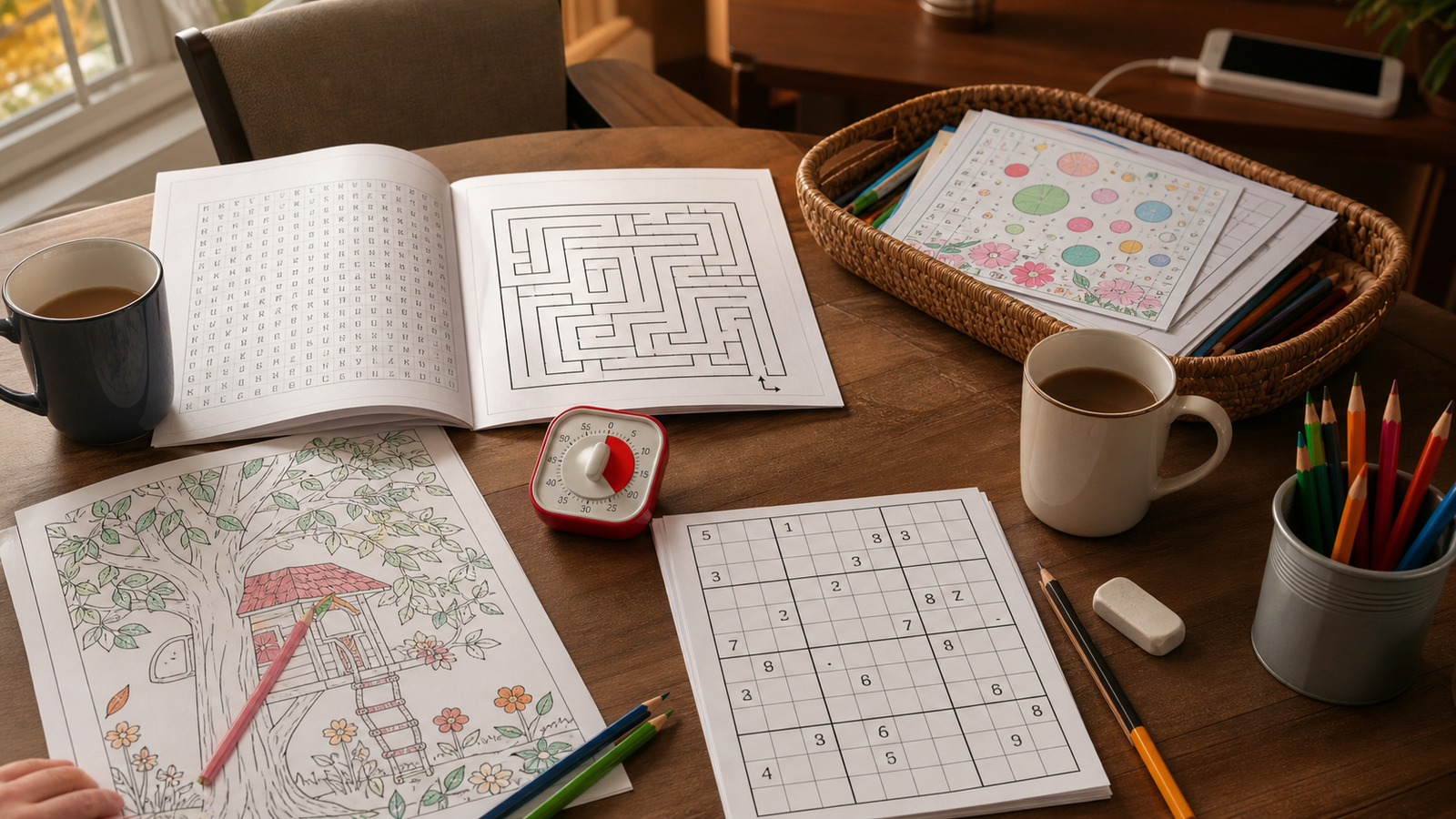
Add one easy word search book, one coloring book or printable page stack, one maze page, one beginner Sudoku option, pencils, colored pencils, an eraser, and a timer. Keep the first version almost embarrassingly simple.
The goal is not to replace every screen forever. The goal is to interrupt the automatic reach for ten to twenty minutes.
Use the Home Bell-to-Bell Rule
Schools use bell-to-bell rules because the boundary is clear. Families can borrow the clarity without copying the whole enforcement model.
Try this: from backpack drop to snack finish, paper first.
That is the home bell-to-bell rule. It gives the after-school transition a defined start and end. The phone is not gone forever. It is just not the first thing.
For younger kids, paper first might mean coloring one animal, tracing one maze, or finding five hidden words. For older kids, it might mean a full word search, one Sudoku row, a harder maze, or one corner of an adult coloring page. For the parent, it might mean sitting nearby for five minutes instead of managing the reset from across the room.
Why Paper Works Here
Paper works because it changes the shape of the moment.
A phone is private, endless, and engineered to keep going. A paper puzzle is public, finite, and easy to share. A word list gets finished. A maze has an exit. A coloring section can be done enough. A Sudoku row can be solved.
That finish line matters after school. Kids do not always need a huge enrichment activity. Sometimes they need a simple object that helps the nervous system shift from school day to home day.
Paper also lowers the social temperature. A parent can circle one word while a child colors. A sibling can race through a maze. A grandparent can keep a large-print puzzle nearby. Nobody has to announce that the family is doing a digital wellness intervention.
Do Not Make It a Punishment
The fastest way to kill the reset is to make paper feel like the consequence for wanting a screen.
Keep the language neutral. Try paper first. Pick one page. Ten minutes, then we decide. Choose coloring or word search. You can stop when the timer ends.
That tone matters. The reset is not a moral lecture about kids these days. It is a household design choice. The phone is powerful, so the offline option needs a head start.
Use the AAP 5 Cs Without Turning It Into Homework
The American Academy of Pediatrics 5 Cs guidance asks families to think about the child, content, calm, crowding out, and communication. That framework fits the after-school reset cleanly.
Child: match the paper activity to the actual kid, not the ideal kid. A dinosaur kid gets dinosaurs. A word kid gets word searches. A number kid gets Sudoku. A creative kid gets coloring.
Content: choose paper activities that feel inviting and age-appropriate. Easy is allowed. Familiar is allowed. Funny themes and comfort picks count.
Calm: after school is not the moment to introduce the hardest puzzle in the book. Use low-friction pages first.
Crowding out: notice what the screen is replacing. If it crowds out snack talk, outdoor time, homework starts, quiet creativity, reading, or sleep later that night, protect the first twenty minutes.
Communication: keep the line short enough to repeat. Paper first from backpack to snack. One page before one more screen. Pick a pencil before picking up the phone.
A Five-Day Starter Plan
Day 1: Put the reset station where the device usually appears and ask for ten minutes of paper first.
Day 2: Let the kid choose between coloring, word search, maze, or Sudoku. Do not offer the whole stack.
Day 3: Join for five minutes. Circle one word, color one corner, or solve one row nearby.
Day 4: Move the reset outside, into the car, or to a grandparent bag so the rule can travel.
Day 5: Ask what should stay in the basket next week and remove anything nobody touched.
The home system gets better when the child has some control over the materials. Choice lowers resistance. Visibility lowers friction. Short sessions lower drama.
The Shareable Line
The school phone ban conversation is no longer fringe. The next wave is the home routine that makes the policy livable.
Try this line: the school day is phone-free, and the first twenty minutes home are paper-first.
It is specific. It is copyable. It does not require a perfect parent, a perfect kid, or a full family rebrand.
A phone-free school day can make classrooms calmer. A paper-first after-school reset can make home calmer. The space between those two is where the real habit gets built.
Sources and Further Reading
- UNESCO Global Education Monitoring Report on school phone bans
- University of Michigan Ford School Phones in Focus educator survey
- Pew Research Center How Parents Manage Screen Time for Kids
- American Academy of Pediatrics Family Media Plan
- American Academy of Pediatrics 5 Cs media guidance
- American Academy of Sleep Medicine on bedtime screen use