

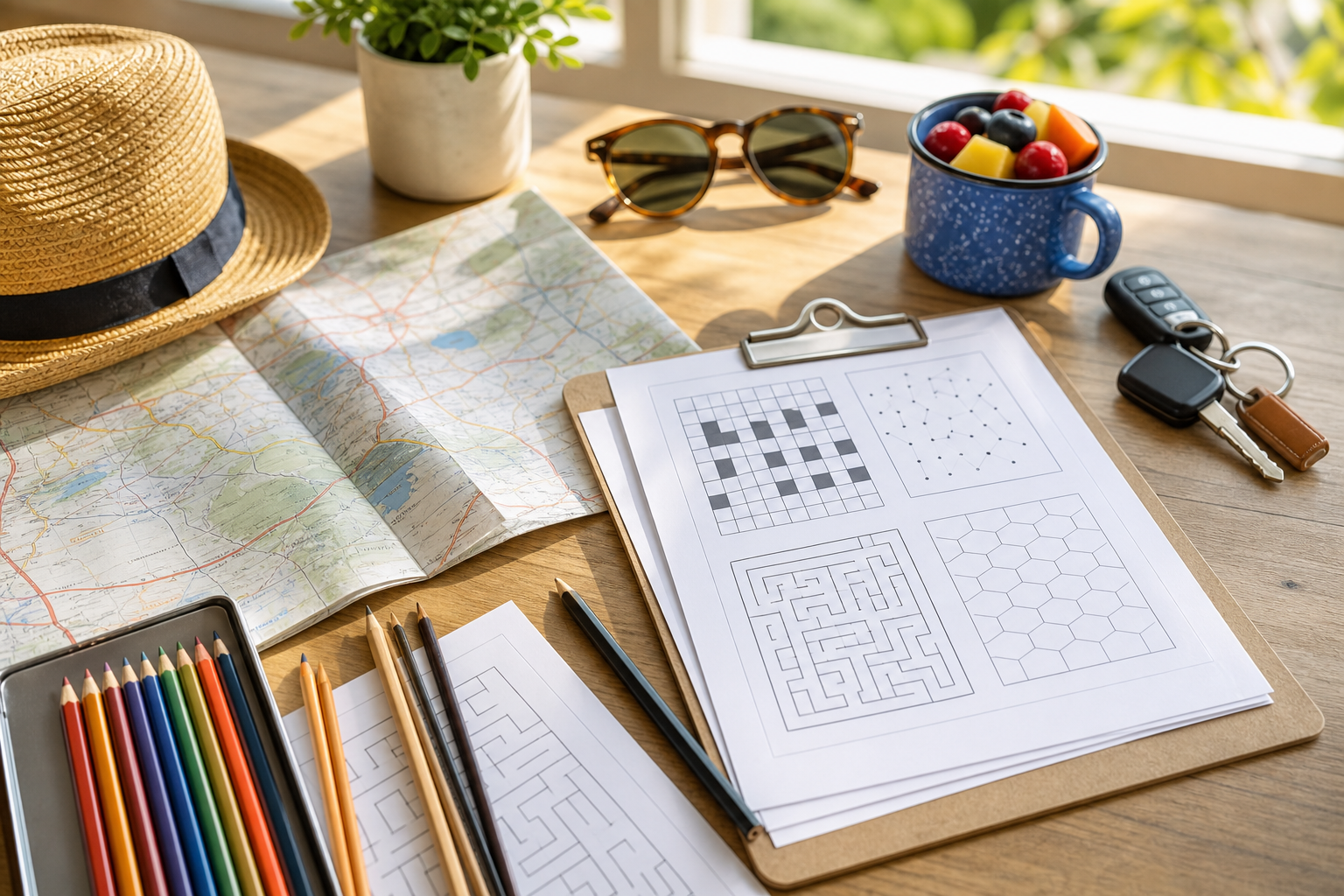


By mid-July, plenty of families are in the same mode: longer drives, fuller calendars, and a growing need for activities that do not rely entirely on a tablet battery. That is exactly why printable road trip puzzles keep earning a spot in glove compartments, tote bags, and seat-back pockets.
The smartest road trip activity is not the loudest one. It is the one that buys you 10 calm minutes here, 15 engaged minutes there, and one less round of “How much longer?” before the next exit. Printable puzzles work because they are flexible. Some can be solved solo. Some invite siblings to team up. Some are quiet enough for a sleepy stretch of highway, while others are perfect for a rest-stop picnic table or hotel lobby wind-down.
A good road trip puzzle pack also travels better than a bulky craft kit. It is lighter, cheaper, easier to reprint, and much easier to hand to kids one page at a time.
Why road trip puzzle packs feel especially useful right now
Summer travel creates a very specific kind of boredom. Kids are excited to go somewhere, but getting there can involve traffic, waiting, snack breaks, and long stretches of not much happening. That is why the best car-friendly activities tend to share a few traits:
• They start fast. No one wants a 5-minute explanation in the middle of a drive.
• They feel like a game, not an assignment. A puzzle should lower friction, not create it.
• They scale across ages. One child may want a maze; another may want a codebreaker.
• They work with minimal supplies. Pencil, clipboard, and a printed stack is enough.
• They can be used in multiple travel moments. Car ride, restaurant wait, hotel quiet time, or rainy vacation afternoon.
That mix is what makes a road trip puzzle pack so shareable. It solves a real problem, and it does it with tools families already understand.
What makes a great travel puzzle
Not every printable puzzle belongs in a moving car. The best road trip versions are built for real travel conditions.
1. One clear job per page
A page should ask for one obvious action: find, match, decode, circle, solve, or continue. If directions are crowded, attention disappears fast.
2. Low writing demand
Short answers work better than paragraph-length work when kids are holding a clipboard in the back seat.
3. Flexible difficulty
A strong pack mixes fast wins with stretch challenges so different ages can stay in the game.
4. Black-and-white friendly design
Families often print at home the night before leaving. The best pack still works without color ink.
5. Quiet replay value
A road trip puzzle earns its spot if it can be solved once, discussed, traded, or remixed with siblings on the next leg.
The 23 printable road trip puzzles worth packing first
Here is a practical mix that works for long drives, short drives, hotel rooms, campgrounds, airports, and vacation rentals.
Word and language puzzles
1. License-plate letter hunt
Pick a target letter or short word family and mark plates, signs, or billboards that match.
2. Road-sign word search
Hide travel words like EXIT, MAP, MOTEL, SNACK, ROUTE, and BRIDGE in a quick grid.
3. Travel word ladder
Change one letter at a time to move from ROAD to READ or TRIP to STOP through legal mini steps.
4. Missing-vowel destination clues
Print words such as H _ T E L, B _ C H, C _ M P, or M _ P and let players restore them.
5. Would-you-pack-it? category sort
Mix words into categories like snacks, beach gear, car items, rainy-day items, and camping supplies.
6. Travel anagram cards
Unscramble words like SUITCASE, PICNIC, ROADSIDE, or PUZZLE.
7. Story-starter clue strip
Give three random travel words and challenge players to create a one-sentence vacation mystery.
Logic and deduction puzzles
8. Who sat where? mini logic grid
Three travelers, three seats, three clues. Fast enough for a short stretch, satisfying enough to feel clever.
9. Snack stop codebreaker
Use number-to-letter clues or symbols to reveal a travel word like EXIT, BRAKE, MAP, or PLAY.
10. Odd-one-out travel card
Example set: seatbelt, gas station, map, toaster. Solvers choose the outlier and explain why.
11. Which route can still fit? puzzle
Give three clues and several route options; players decide which choice can still be true.
12. Packing-list elimination puzzle
Use short clues to figure out who packed the flashlight, puzzle book, sunscreen, or headphones.
13. Rule finder road edition
Show a list of roadside words and ask players to identify the hidden sorting rule.
14. Travel timeline challenge
Put pit-stop events in order using clues like “the gas stop happened before lunch” or “the souvenir shop came after the bridge.”
Observation and visual puzzles
15. Billboard bingo sheet
Fill a grid with things players might spot: red truck, water tower, farm animal, bridge, construction sign, state outline.
16. Cloud-shape sketch prompt
Spot one shape outside, sketch it simply, and turn it into something funny or mysterious.
17. Continue-the-pattern strip
Use icons like tires, arrows, suns, trees, and traffic cones in a sequence players must finish.
18. Micro maze to the next stop
Help the car reach the campground, diner, cabin, or museum.
19. Spot-the-difference travel scene
Compare two tiny roadside or campsite scenes during a quiet break.
Cooperative and family-style puzzles
20. One-clue-at-a-time mystery
Each family member reveals one clue to help solve a shared final answer.
21. Road trip scavenger riddle cards
Instead of saying “find a barn,” give a clue like “I am red, tall, and usually near a field.”
22. Sibling team map challenge
One player reads location clues while the other traces the correct route on a simple printed map.
23. Final destination unlock page
Pull one answer from several earlier puzzles to reveal the trip’s final bonus phrase or secret travel award.
Three mini examples you can print tonight
These examples are easy to test before building a bigger pack.
Example 1: License-plate letter challenge
Pick one letter for the next 20 minutes.
Challenge: Circle every license plate or road sign that includes the letter R.
Why it works: Even younger kids can join, and older kids can race for totals or make it harder by hunting two-letter combinations.
Example 2: Tiny codebreaker
Use A=1, B=2, C=3.
5 - 24 - 9 - 20
Answer: EXIT.
Example 3: Mini logic puzzle
Maya, Theo, and June each brought one travel item: headphones, a puzzle book, and binoculars.
• Maya did not bring the headphones.
• Theo did not bring the binoculars.
• June did not bring the puzzle book.
Answer: Maya brought the binoculars, Theo brought the puzzle book, and June brought the headphones.
These small examples matter because they remove setup friction. Once players understand the format, you can hand them a fresh page without another full explanation.
How to build a no-meltdown road trip puzzle kit in 10 minutes
You do not need a fancy binder. A practical travel kit can be assembled quickly.
Start with:
• 3 quick word puzzles.
• 3 logic puzzles.
• 2 observation games.
• 2 visual puzzles or mazes.
• 1 final unlock sheet.
• 1 answer key for adults or older kids.
• pencils or erasable pens.
• a thin clipboard or hard-backed folder.
• optional page protectors for reuse.
If the trip includes multiple ages, make two mini stacks: one easier, one more challenging. That prevents every page from becoming a negotiation.
The best times to use each type of puzzle
A smart travel pack works because it matches the moment.
For the first hour of the drive
Use easy wins: bingo, letter hunts, or missing-vowel clues. The goal is momentum, not complexity.
For the sleepy middle stretch
Bring out quieter solo pages like mazes, codebreakers, or pattern strips.
For rest stops and meal waits
Use cooperative puzzles, map challenges, or scavenger riddles that work well with conversation and movement.
For hotel or rental downtime
Shift to longer logic puzzles, story prompts, or final unlock pages that feel more like family game night.
A simple 3-hour drive puzzle rotation
If you want a ready-made rhythm, this one works well:
1. Minutes 1 to 20: Billboard bingo or license-plate hunt.
2. Minutes 21 to 45: One word puzzle and one missing-vowel card.
3. Minutes 46 to 70: Snack break or quiet window time.
4. Minutes 71 to 100: Mini logic grid or codebreaker.
5. Minutes 101 to 130: Cooperative scavenger riddle or map puzzle.
6. Minutes 131 to 180: Final unlock page or story-starter challenge.
That format helps because the activity changes before attention fully drops off.
How to keep it fun for mixed ages
The easiest mistake is giving every traveler the exact same challenge. A better approach is to vary the role instead of the page.
• Let younger kids spot and circle.
• Let older kids decode and explain.
• Let one child read clues aloud.
• Let another child check answers.
• Let adults join the final shared puzzle so the activity feels social instead of supervisory.
This matters because the most successful travel activities do not just fill time. They create small moments of shared problem-solving.
Practical takeaway
If you want one printable idea that families will actually use this season, make it road-trip friendly. The best pack does not try to impress with complexity. It wins by being easy to print, easy to hand out, and easy to adapt when the mood in the car changes.
A road trip puzzle pack works because it solves several problems at once: boredom, transition time, device fatigue, and mixed-age travel pacing. It also gives parents, grandparents, and older siblings a simple way to reset the energy without needing a big setup.
Conclusion
The most viral printable ideas are usually the ones that feel immediately useful. A road trip puzzle pack has that advantage. It is practical, screen-light, easy to personalize, and flexible enough for car rides, rest stops, restaurants, and hotel quiet time.
It is the kind of practical summer guide people can save, send to friends, and print before the next drive.