
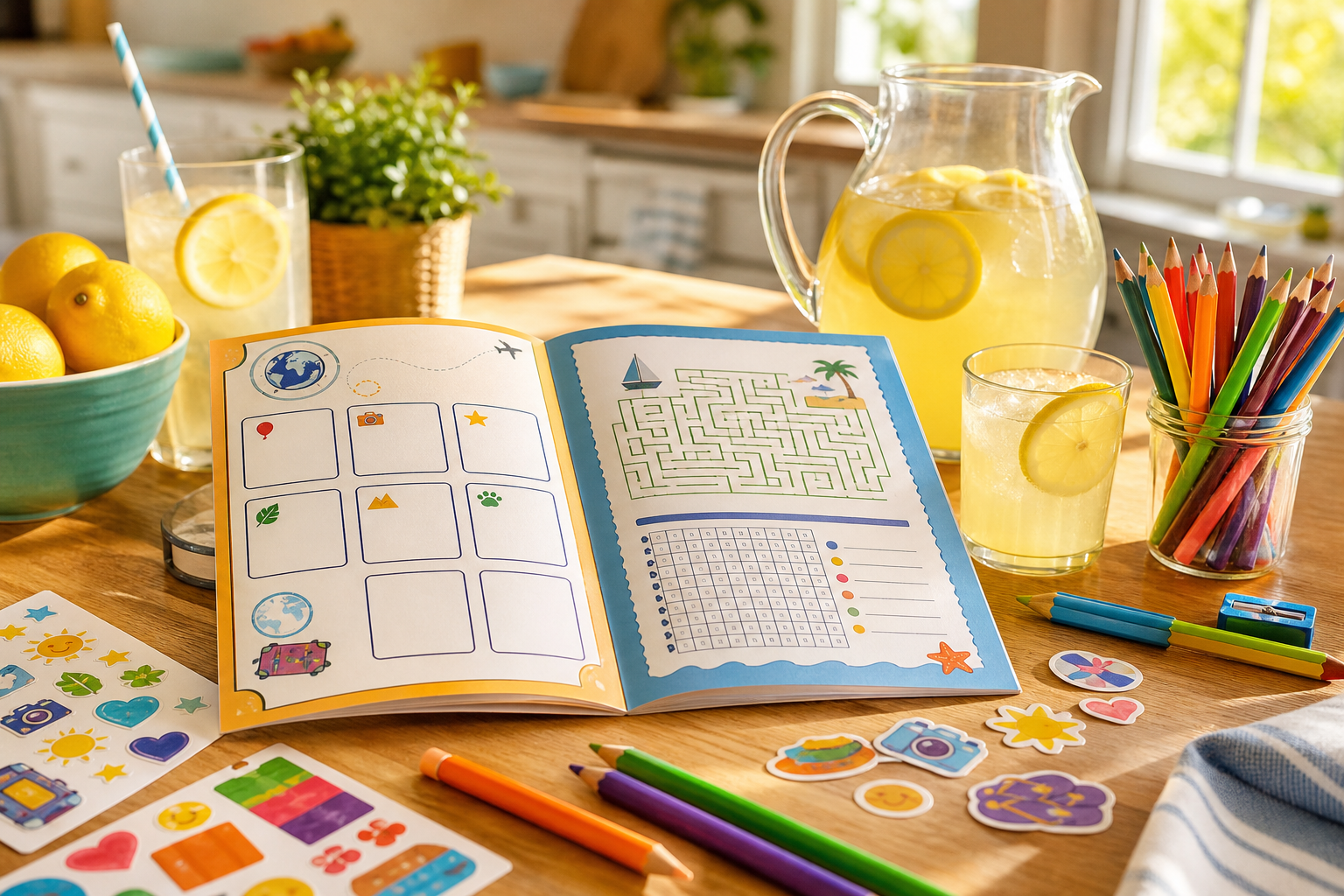


A printable puzzle passport is the easiest way to make a stack of short paper puzzles feel like an event. Instead of handing out one maze, one word search, or one logic grid, give each player a passport page with missions to complete, boxes to stamp, and a final challenge that unlocks the finish line.
That simple frame matters right now. Daily digital puzzles have trained people to enjoy quick, repeatable wins, while parents, teachers, librarians, and camp leaders still need activities that work without logins, screens, headphones, or fragile supplies. A puzzle passport borrows the satisfying progress loop of a game and turns it into a printable format you can run at a kitchen table, classroom, library desk, vacation rental, or summer camp room.
Why Puzzle Passports Are a Strong Summer Format
Current puzzle interest is broad, not niche. The New York Times Games page for July 3, 2026, showed a full menu of daily games including Crossword, Mini, Wordle, Connections, Strands, Sudoku, Letter Boxed, Tiles, Pips, and the new Crossplay. Education.com’s puzzle worksheet results organize printable puzzle resources by game type, including mazes, crosswords, memory games, dot-to-dot, and printable board games. We Are Teachers is actively surfacing summer printables, brain breaks, and summer learning resources. The National Summer Learning Association emphasizes access to high-quality summer learning experiences and combatting summer learning loss.
The practical takeaway for Puzzle Playbooks readers: families and educators do not need one giant activity. They need small puzzle missions that feel organized, social, and worth finishing. A passport gives those missions a visible structure.
What Makes It Different From a Worksheet Packet
A worksheet packet says, 'finish these pages.' A puzzle passport says, 'complete the missions and collect the stamps.' The puzzles can be almost identical, but the experience changes. Players see progress. Hosts can add choice. Groups can compare routes. The finished page becomes a keepsake instead of another loose sheet that disappears under the table.
Best Uses
Use a puzzle passport for summer camp rotations, library summer reading tables, classroom warmups, rainy-day vacation activities, birthday party arrivals, homeschool morning baskets, road trip rest stops, or family game night. It works best when the total play time is 20 to 45 minutes and each mission can be solved in three to eight minutes.
The One-Page Passport Template
Start with one landscape page folded in half or one full-page sheet on a clipboard. Put the title at the top, then create six mission boxes. Each mission box should include a short label, a puzzle type, and an empty stamp or sticker space.
A strong beginner passport might include: Maze Map, Word Ladder, Mystery Match, Pattern Code, Mini Search, and Final Riddle. For younger kids, use pictures, large spaces, and fewer written instructions. For older kids, teens, and adults, make the missions shorter but trickier: a mini logic grid, a substitution code, a category sort, a lateral-thinking clue, a nonogram-style picture, or a two-step riddle.
Sample Mission Set
Mission 1: solve a simple maze from Start to Campfire. Mission 2: change SUN to FUN by changing one letter at a time. Mission 3: sort 12 words into three secret categories. Mission 4: decode a four-symbol message using a key. Mission 5: find eight hidden summer words in a tiny word search. Mission 6: use the answers from Missions 1 through 5 to solve the final riddle.
Easy Scoring Rule
Give one stamp for each completed mission and one bonus stamp for teamwork, neat solving, or helping another player without giving away an answer. The bonus stamp is useful because it rewards behavior the host actually wants: persistence, explanation, and calm problem-solving.
How to Run a Puzzle Passport in 30 Minutes
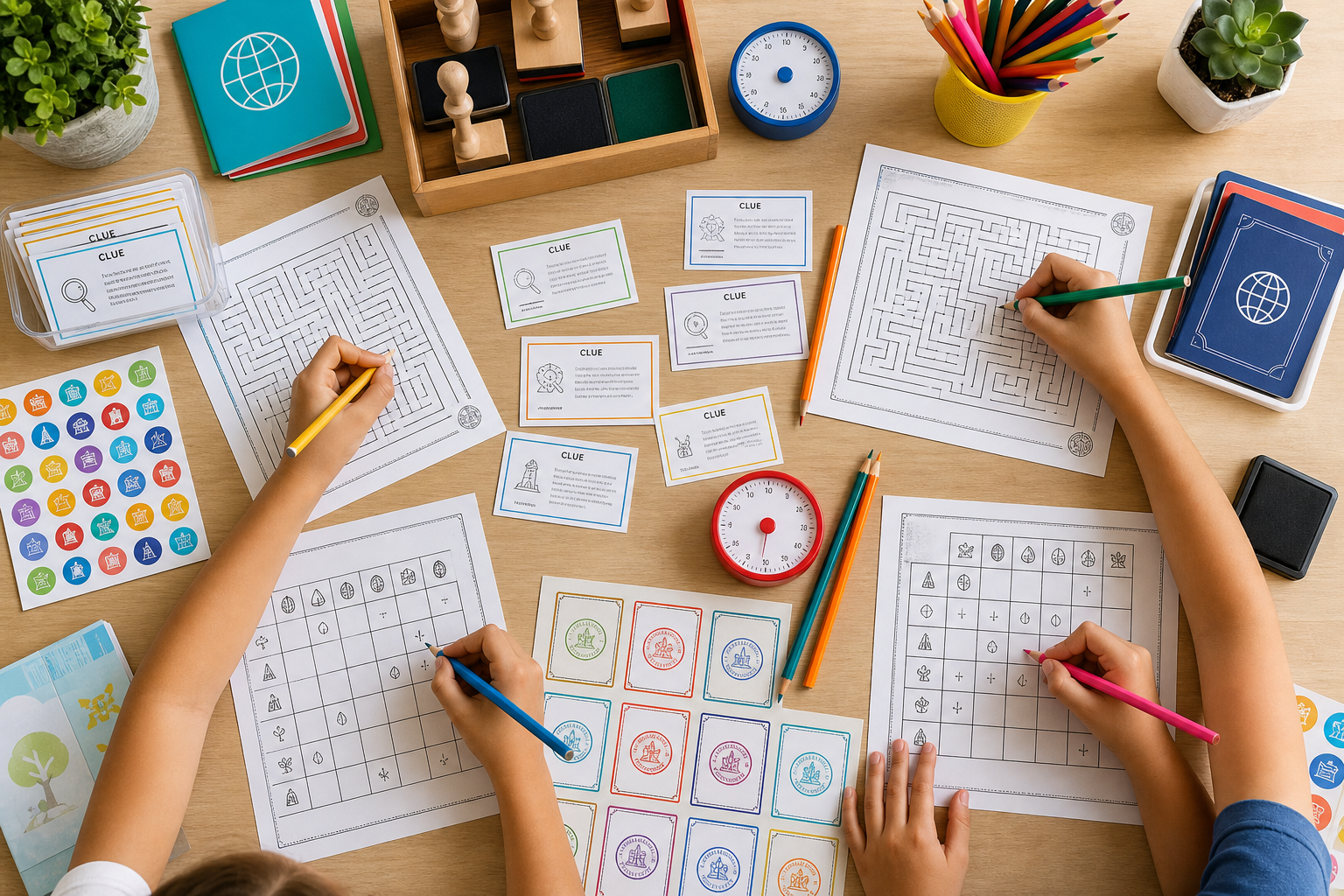
The simplest setup is four stations and six passport boxes. Players start anywhere, solve a mission, show the host or station leader, collect a stamp, then move to another station. If you have only one adult, keep the answer key on a clipboard and let players line up for checks. If you have several helpers, assign one helper per station.
For a family version, skip stations and put all mission cards in the center of the table. Each player chooses any mission, solves it, and stamps their own passport after a quick host check. For a classroom or library version, stations create better movement and make the activity look more special without adding much cost.
Materials Checklist
Print one passport per player, one mission card set per table, and one answer key for the host. Add pencils, erasers, stickers or stamps, a timer, folders or trays for station cards, and a small prize if the setting expects one. The prize can be tiny: a bookmark, a sticker sheet, a pencil, or the right to choose the next family game-night snack.
Timing Plan
Use five minutes for explanation, twenty minutes for missions, and five minutes for the final riddle or photo-worthy finish. If the group is younger, remove the final riddle and celebrate any four completed stamps. If the group is older, add a bonus mission that only opens after all regular boxes are stamped.
Puzzle Types That Work Best in a Passport
Passport puzzles need fast starts. Avoid puzzle types that require long rule explanations or heavy reading. The best mission is understandable in ten seconds and satisfying in under eight minutes.
Good passport formats include mazes, word ladders, mini word searches, spot-the-pattern grids, match-the-clue cards, category sorts, symbol ciphers, rebus clues, simple logic grids, hidden-object lists, and mini Sudoku-style number boxes. Mix word, visual, and logic puzzles so different players get a chance to shine.
Three Difficulty Ladders
For ages 5 to 7, use picture clues, mazes, tracing paths, rhymes, and matching. For ages 8 to 11, add word ladders, category sorts, basic codes, and short riddles. For teens and adults, use tighter constraints: fewer hints, mixed clue types, and answer chaining where one mission’s answer unlocks the next.
A Host-Friendly Hint System
Put three hint levels on the answer key. Hint 1 points players back to the rule. Hint 2 narrows the search. Hint 3 gives the next useful step. This keeps the activity moving without turning the host into an answer machine. A good hint preserves the aha moment; it does not erase it.
Make the Passport Feel Collectible
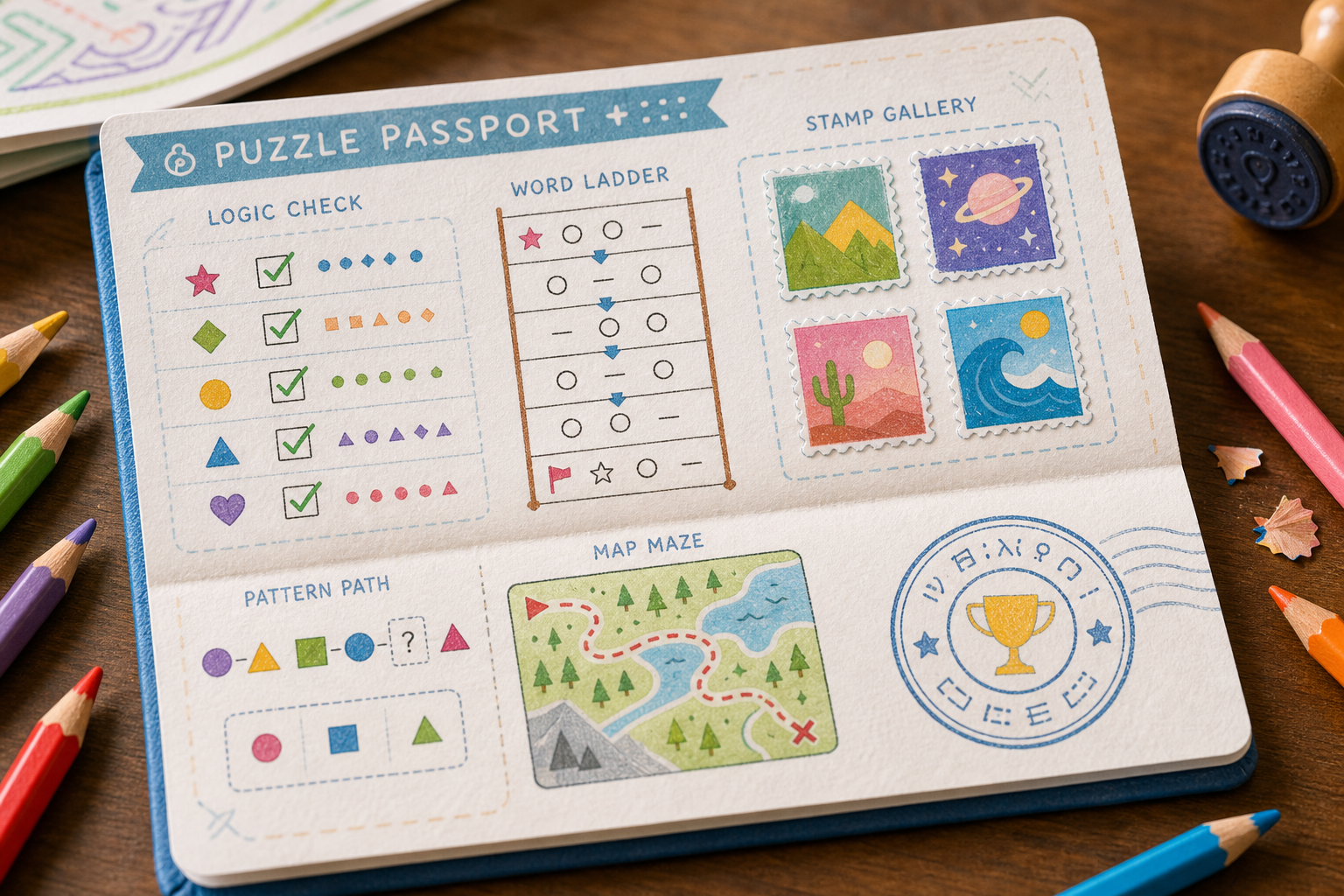
The collectible feeling makes the activity more satisfying to finish and share. Add a playful cover title, a blank name line, six stamp spaces, and one completion badge area. Use stickers if you have them, but checkmarks, initials, hole punches, or colored pencil marks work too.
The visual goal is not perfection. The goal is evidence of progress. A finished passport should look touched, solved, and earned. That is why big boxes, generous margins, and visible mission names matter more than decorative clutter.
Theme Ideas
Try Camp Quest, Library Explorer, Backyard Detective, Rainy Day Rescue, Road Trip Ranger, Puzzle Museum, Space Station Search, Ocean Clue Dive, or Time-Travel Trail. Keep the theme generic enough that the puzzles still do the work. A good theme adds momentum; it should not require a costume bin or a full party budget.
Replay Twist
After players finish, ask them to design one new mission for tomorrow’s passport. This turns solvers into puzzle makers. It also gives educators and parents a fast assessment: if a child can create a clear clue, they understood the puzzle structure.
Printable Production Tips
Design for black-and-white printing first. Color is nice, but the passport should still work from a home printer or library copier. Use thick borders around stamp boxes, leave room for handwriting, and keep every instruction close to the puzzle it explains.
Before you run the activity with a group, test every mission yourself and then test it with one person who has not seen the answer key. If the tester asks, "What am I supposed to do?" rewrite the instruction. If the tester solves instantly, keep it as a warmup. If the tester gets stuck for more than ten minutes, add a hint or move that puzzle to the bonus round.
Common Mistakes
Do not make every mission the same puzzle type. Do not hide critical instructions in tiny text. Do not require internet access for one mission if the rest of the event is screen-free. Do not make stamps dependent on speed alone; slower careful solvers should still feel successful.
More Printable Puzzle Ideas
Pair this passport idea with the 10-minute word ladder race for a quick word mission.
Use the printable puzzle relay when you want a more active team version.
Borrow station ideas from Summer Brain Camp at Home when you need a full afternoon setup.
Start With the One-Page Version
Want the easy version? Build a one-page puzzle passport with six boxes, three puzzle types, and one final riddle, then keep a basket of Puzzle Playbooks-style printable puzzle books nearby for players who want the next challenge after the stamps are done.