




The new parenting flex is not the newest kid-safe tablet. It is a child who can be bored for ten minutes without the room collapsing.
That is why the phone-free childhood movement is spreading. Parents are not suddenly anti-technology. They are tired of watching childhood get routed through autoplay, group chats, short videos, games, and devices that are always ready before the kid is.
Axios reported in May 2026 that parents in the United States and abroad are joining efforts to delay smartphones and reduce children's screen time. That matters because the conversation has moved from private guilt to shared norms. More parents are asking the same question at the same time: what do we put in childhood before the phone gets there first?
Here is the uncomfortable part. Phone-free is not a full plan. It is a boundary. A boundary creates space, and empty space gets loud fast.
If a kid has been trained by a device to expect instant novelty, the first few minutes of boredom can feel like failure. That is not a reason to give up. It is the exact reason the home needs an obvious first offline move.
The Boredom Gap
The hardest part of reducing screen time is not the rule. It is the first ten minutes after the rule.
Parents can delay smartphones, remove tablets from bedrooms, set screen windows, and rewrite family rules. All of that helps. But when a child says there is nothing to do, the house needs a better answer than a speech about attention spans.
Common Sense Media's 2026 State of Kids and Families report found that parents and youth still point to social media, technology, and screen time as a main cause of today's mental health crisis. Pew's screen-time research also shows how many parents are not debating whether screens matter. They are wrestling with how much is too much, especially around tablets, smartphones, games, and preteen social media.
The Institute for Family Studies put the problem in blunt terms in its May 2026 High Tech, Low Play brief: American kids spend far more time on internet-enabled devices than playing outside without adult supervision. That is bigger than one household. But the first household move can still be small.
Give boredom somewhere to go.
The Paper Puzzle Basket
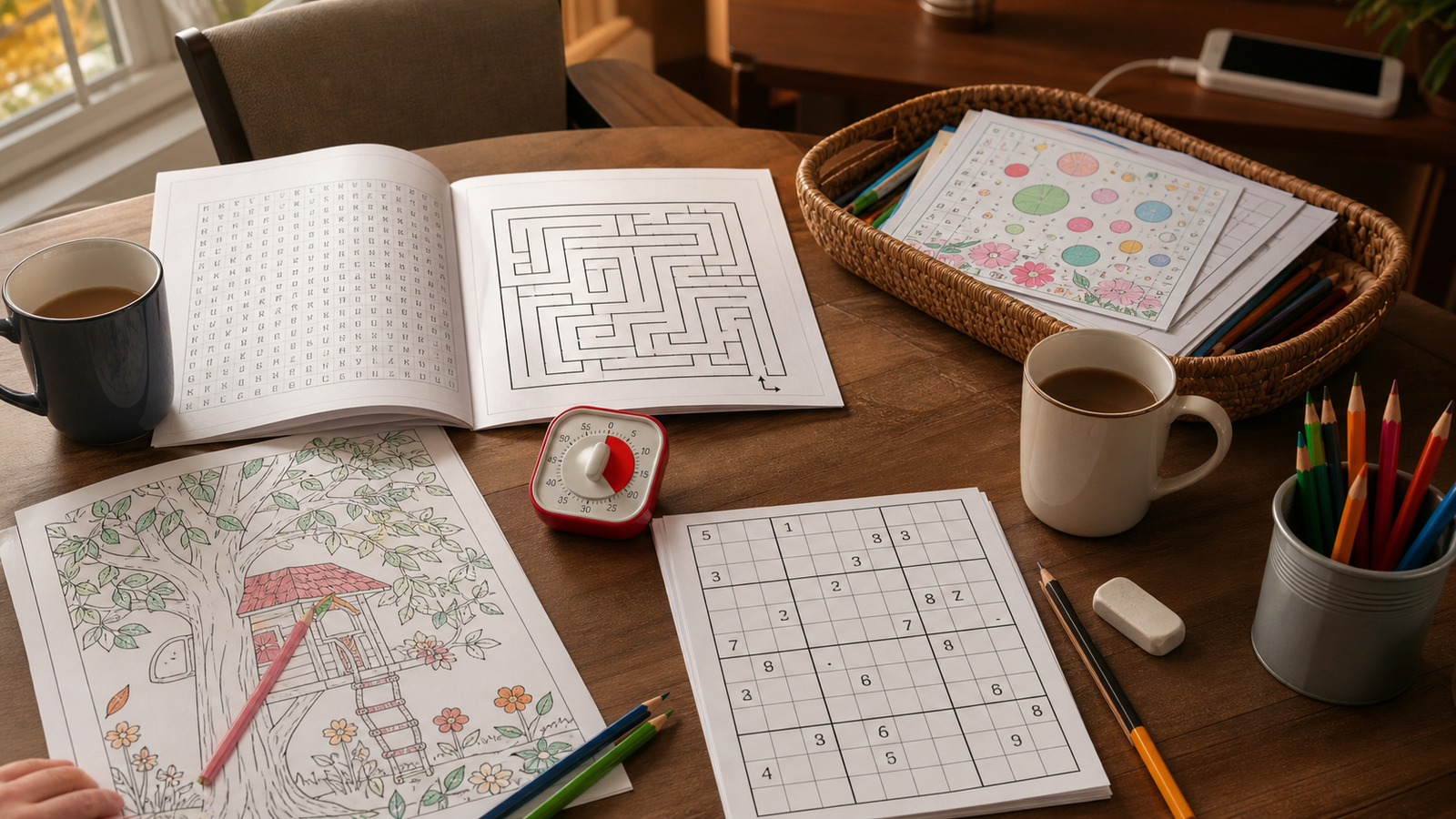
A paper puzzle basket is not a nostalgic decoration. It is a friction hack.
Put a small basket where the screen habit usually starts: kitchen table, coffee table, porch, camper, grandparent bag, waiting-room tote, or nightstand. Add coloring pages, a word search book, easy mazes, beginner Sudoku, pencils, colored pencils, an eraser, and one book that feels almost too easy.
The basket works because it wins the first move. A puzzle in a closet loses to a tablet on the counter. A visible coloring page can compete. An open word search can compete. A pencil beside a maze can compete.
This is not about pretending paper is magic. It is about making the offline option obvious before the online option becomes automatic.
Why It Feels Different From Another App
A good educational app can be useful. A family movie can be fun. A browser game can be an intentional break. The problem is not every screen. The problem is the pocket-sized default that fills every pause before a child has a chance to feel the pause.
Paper changes the room. It puts the activity on the table instead of inside a private rectangle. A parent can circle a word while a child colors. A grandparent can solve a large-print puzzle nearby. A sibling can race through a maze in a different pencil color.
Paper also ends. A word list gets finished. A maze has an exit. A coloring corner looks done. A Sudoku row can be solved. That natural stopping point is a quiet advantage in a house full of feeds designed to keep going.
Use the First-Ten-Minutes Rule
Do not start with a full summer detox. Start with the first ten minutes.
When a child reaches for a device, try this line: ten minutes at the basket first. The screen can wait until the timer rings.
That sentence works because it is short, specific, and survivable. It does not require a perfect parent or a perfect kid. It asks for one paper start before the next digital pull.
For younger kids, ten minutes can mean coloring one dinosaur, tracing one maze, or finding five hidden words. For elementary kids, it can mean circling ten words, solving one Sudoku row, or finishing one page in an activity book. For teens and adults, it can mean one word search, one logic puzzle, or one corner of an adult coloring page.
What Goes in the Basket
Start with easy wins. The first basket should not be a museum of ambitious activities nobody touches.
For preschoolers, use thick-line coloring pages, ABC pages, animal themes, simple mazes, and washable tools. For elementary kids, add word searches, hidden pictures, joke prompts, harder mazes, and beginner Sudoku. For families, add adult coloring, large-print word search, and easy Sudoku so the rule does not feel like a kids-only punishment.
Rotate one item every few days. A new page is enough. Novelty does not have to mean a new app, toy, or subscription.
Use the AAP 5 Cs Without a Lecture
The American Academy of Pediatrics encourages families to think about the child, content, calm, crowding out, and communication when making media choices. A puzzle basket turns that framework into a table routine.
Child: choose for the actual kid. A dinosaur kid gets dinosaurs. A pattern kid gets coloring. A number kid gets Sudoku. A word kid gets a word search.
Content: treat paper content with the same care you would use for screen content. It can be calming, funny, creative, social, challenging, or nostalgic.
Calm: use easy pages when the room is already tense. Hard puzzles are for focused moods, not for the first reset after a meltdown.
Crowding out: notice what the device is replacing. If it is crowding out sleep, outdoor play, family talk, reading, or quiet creativity, protect one small piece of that space with paper first.
Communication: keep the rule repeatable. Ten minutes at the basket first. One page before one more screen. Pick a puzzle for the table.
A Seven-Day Starter
Day 1: Put the device away and finish the easiest page in the basket.
Day 2: Circle ten words in a word search before the first afternoon video.
Day 3: Color one corner of a page and stop while it still feels good.
Day 4: Try a maze, then let someone else trace the same path in another color.
Day 5: Solve one easy Sudoku row, box, or full grid depending on the solver.
Day 6: Move the basket to a new place, such as the porch, car, camper, or grandparent bag.
Day 7: Let each person choose next week's paper activity.
The point is not perfect screen-free childhood. Perfect is too fragile. The point is giving the family a better default when the first bored minute shows up.
The Shareable Rule
The phone-free childhood backlash is becoming a movement because parents are realizing they do not have to solve this alone. Shared norms help. So do small household systems that are easy to copy.
Try this: before the next screen, go to the basket first.
That is not a moral panic. It is a practical reset. Childhood needs room for boredom, but boredom needs a bridge. A pencil, a page, and a visible basket are enough to build the first one.
Sources and Further Reading
- Axios on the screen-free childhood movement
- Common Sense Media State of Kids and Families in America 2026
- Pew Research Center How Parents Manage Screen Time for Kids
- Institute for Family Studies High Tech, Low Play May 2026
- American Academy of Pediatrics Family Media Plan
- American Academy of Pediatrics 5 Cs media guidance