

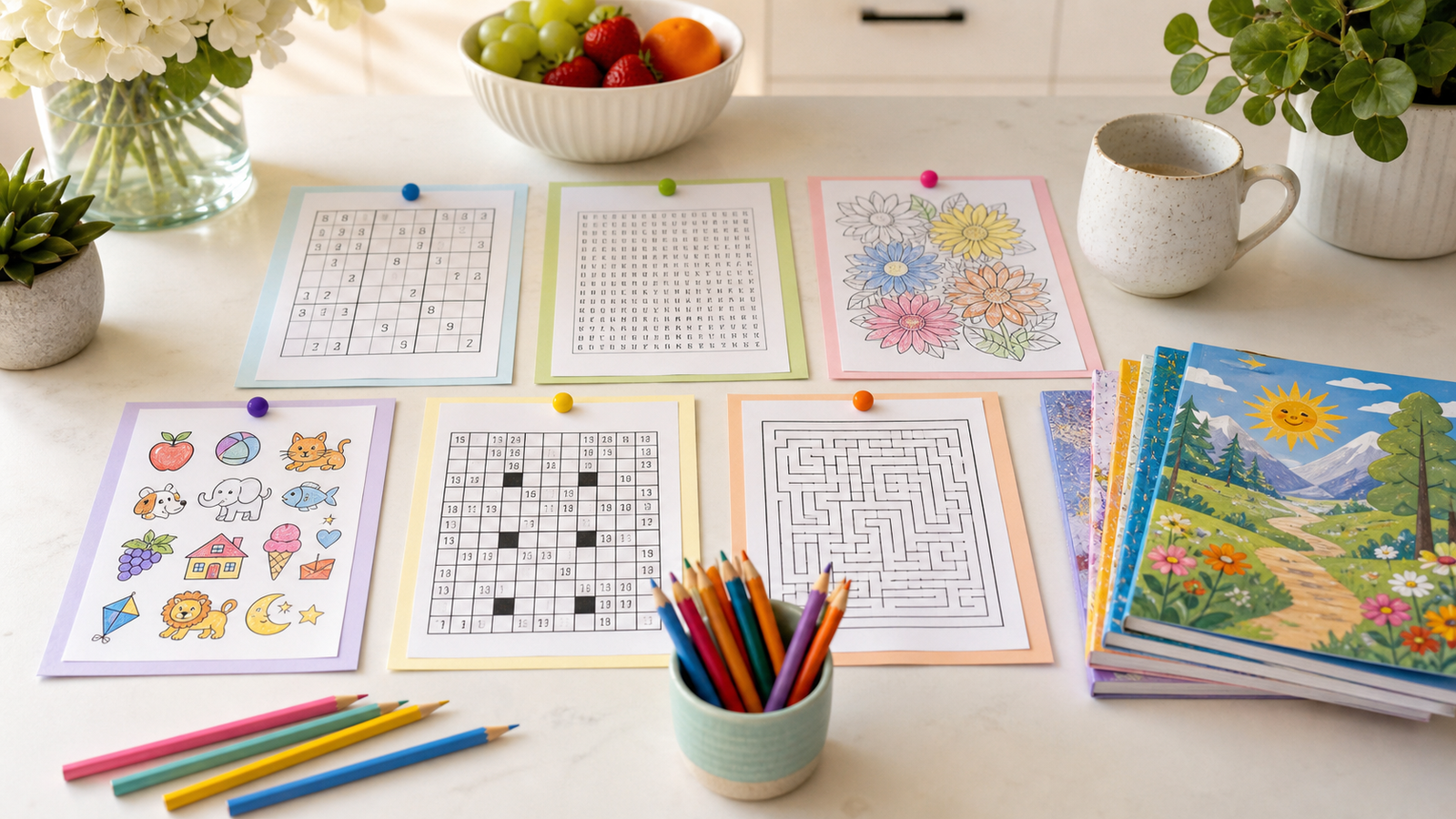

The easiest screen-free challenge is not a thirty-day detox, a perfect family rule, or a dramatic app deletion. It is one page before one more scroll.
Put the phone face down. Open a puzzle book. Finish one page, one word list, one Sudoku box, one maze, or one coloring corner. Then decide whether you still want the feed.
That tiny pause is the whole trick. A paper puzzle does not need to beat the internet forever. It only needs to interrupt the automatic reach long enough for your brain to remember that quiet fun still exists.
The Rule
The one-page rule is simple: before the next scroll, video, game, or app check, do one paper puzzle page or one visible piece of a page.
For adults, that might mean one easy Sudoku grid after dinner, ten words in a word search, or one small corner of an adult coloring page. For kids, it might mean an ABC coloring page, a dinosaur maze, a hidden-word list, or a printable challenge card. For seniors, it might mean a large-print word search under a good lamp.
The page does not have to be hard. It should be easy enough to start when everyone is tired. The goal is not achievement. The goal is a better first move.
Why It Spreads
Good challenges spread because they are easy to copy. The one-page rule fits in one sentence, one photo, and one table setup. A face-down phone beside an open puzzle book tells the story without a lecture.
It also gives people a challenge that does not demand a new identity. Nobody has to become a perfect minimalist or a screen-free purist. You only have to finish one small paper task before the next digital one.
That makes it useful in real homes. Parents can use it when summer afternoons get loose. Adults can use it when the couch turns into an accidental scrolling zone. Grandparents can use it during quiet visits. Teachers and caregivers can use it as a low-pressure reset between louder activities.
What Counts As One Page
A whole page counts, but so does one clear piece of a page. Circle ten words. Fill one Sudoku row. Color one flower. Trace one maze. Finish one letter activity. Add a border to a printable coloring card. The smaller the win, the more likely people are to repeat it.
This matters because huge goals often fail at the starting line. A visible, finishable puzzle gives the brain a clean stopping point. That stopping point is exactly what many digital feeds avoid.
Set Up the Two-Minute Table
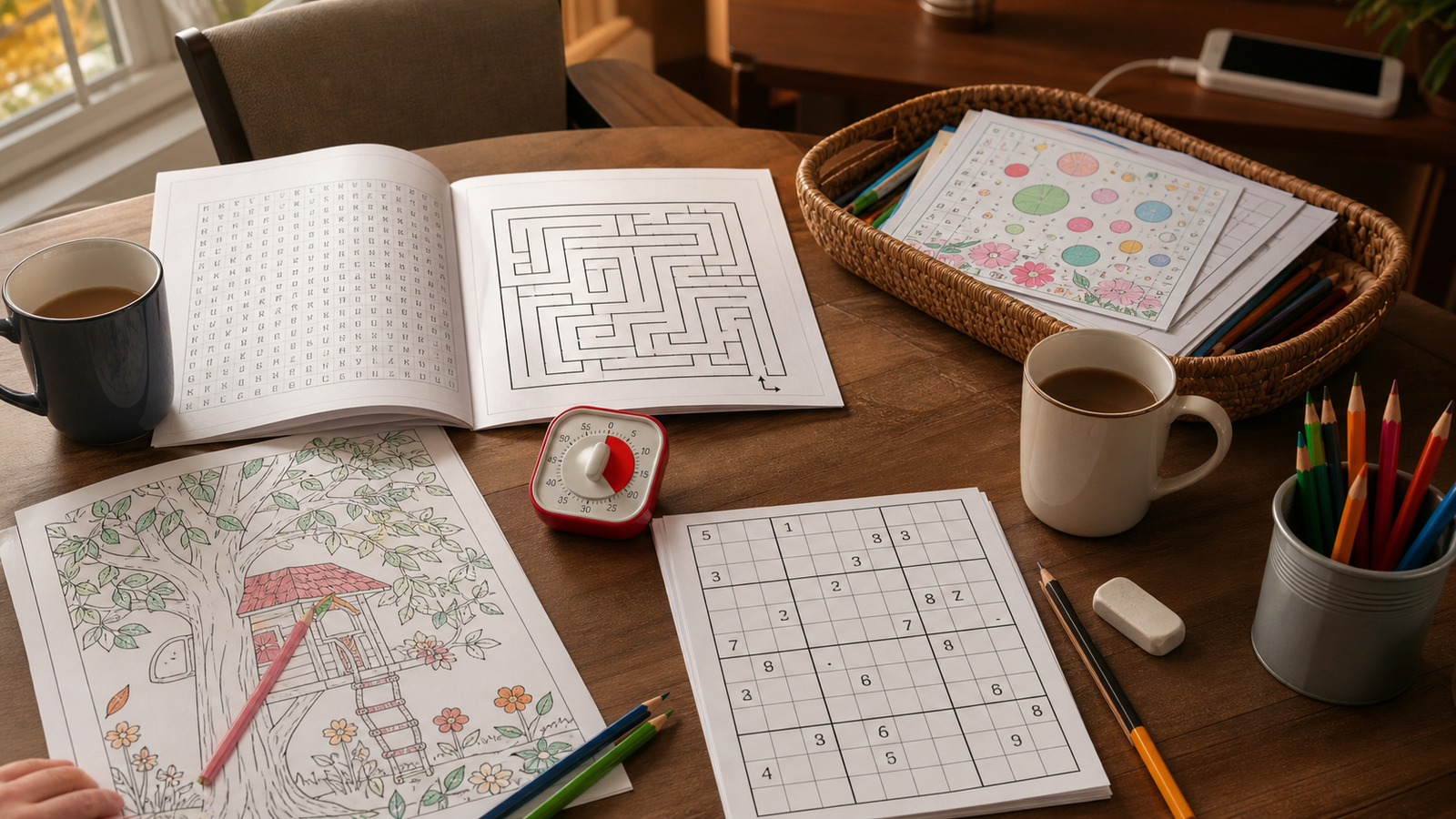
The setup should take less than two minutes. Put one book, one pencil, one eraser, and one coloring option where the screen habit usually starts. That might be the kitchen table, coffee table, nightstand, porch, camper, office desk, grandparent bag, or travel tote.
Keep the phone out of the setup. Charge it across the room, turn it face down, or place it under a book while the page is open. The point is not to shame anyone for using a phone. The point is to stop making the phone the easiest object to pick up.
For families, add two or three choices. A younger child might choose coloring. An older child might choose a maze or word search. An adult might choose Sudoku. Everyone can work on a different page while still sharing the same quiet table.
Use The Five Cs Without A Lecture
The American Academy of Pediatrics encourages families to think about the child, content, calm, crowding out, and communication when making media choices. The one-page rule turns that conversation into a practical swap.
Child: pick the puzzle that fits the person in front of you. A dinosaur kid gets dinosaurs. A number kid gets Sudoku. A tired adult gets an easy word search. A detail-loving colorist gets a mandala or fantasy page.
Content: choose paper content with the same care you would choose screen content. A puzzle can be calming, funny, social, nostalgic, creative, or challenging.
Calm: use easy pages for the first swap. If the household is already tense, do not start with the hardest logic puzzle in the book.
Crowding out: notice what the screen is replacing. If the scroll is crowding out sleep, dinner talk, creative time, reading, or quiet play, protect one small piece of that space with paper first.
Communication: keep the line short. One page before one more screen. Pick a puzzle for the table. Color with me until the timer rings.
A Seven-Day Version
Day 1: Put the phone face down and finish the easiest page you can find.
Day 2: Circle ten words in a word search before opening a social app.
Day 3: Color one corner of a page and stop while it still feels good.
Day 4: Give a child a maze or coloring page and sit nearby with your own puzzle.
Day 5: Try one large-print page, even if you do not usually need large print.
Day 6: Put the puzzle basket somewhere new: porch, car, waiting room, lunch table, or nightstand.
Day 7: Choose next week's table book and leave it visible.
The challenge is allowed to be imperfect. A half-finished page still changed the default. A five-minute attempt still gave the brain a different path.
Best Puzzle Types For The Rule
Coloring pages are best when the day felt loud and nobody wants more rules. Word searches are best when you want a quick win. Sudoku is best when you want a cleaner logic challenge. Mazes are best for kids who like movement and visible progress. Large-print puzzles are best when comfort matters more than density.
A good home setup usually includes more than one type. The one-page rule works because people can choose by mood instead of forcing every break to look the same.
Where PuzzlePlay Books Fits
PuzzlePlay Books is built around easy-start paper activities: adult coloring books, Sudoku puzzle books, word search books, kids activity books, large-print puzzles, printable coloring tools, and simple browser games for intentional breaks.
Start with the Puzzle Book Finder if you want help choosing by age, mood, and activity type. Use the shop when you want paper books. Use the free puzzles and games page when you want a quick intentional game rather than an endless feed.
The Takeaway
The feed will still be there after the page is done. That is the point. One page before one more scroll is small enough to try tonight and specific enough to share with someone who needs a calmer first move.
Put the phone down for one page. Not forever. Just one page.
