



The screen returns in one of two ways.
Either it becomes a tool, or it becomes the default default behavior.
Most people know it is a problem. Fewer people can name why they lose.
The reason is not weakness.
The reason is momentum.
When the first move is instant, most homes lose the reset.
The one-page reset works because it changes the first move.
Before touching another screen, open exactly one paper page and begin a visible, short session.
Not a full routine.
Not a speech.
Not a full shop run.
Just one page.
One page before the next scroll.
The setup is the whole system.
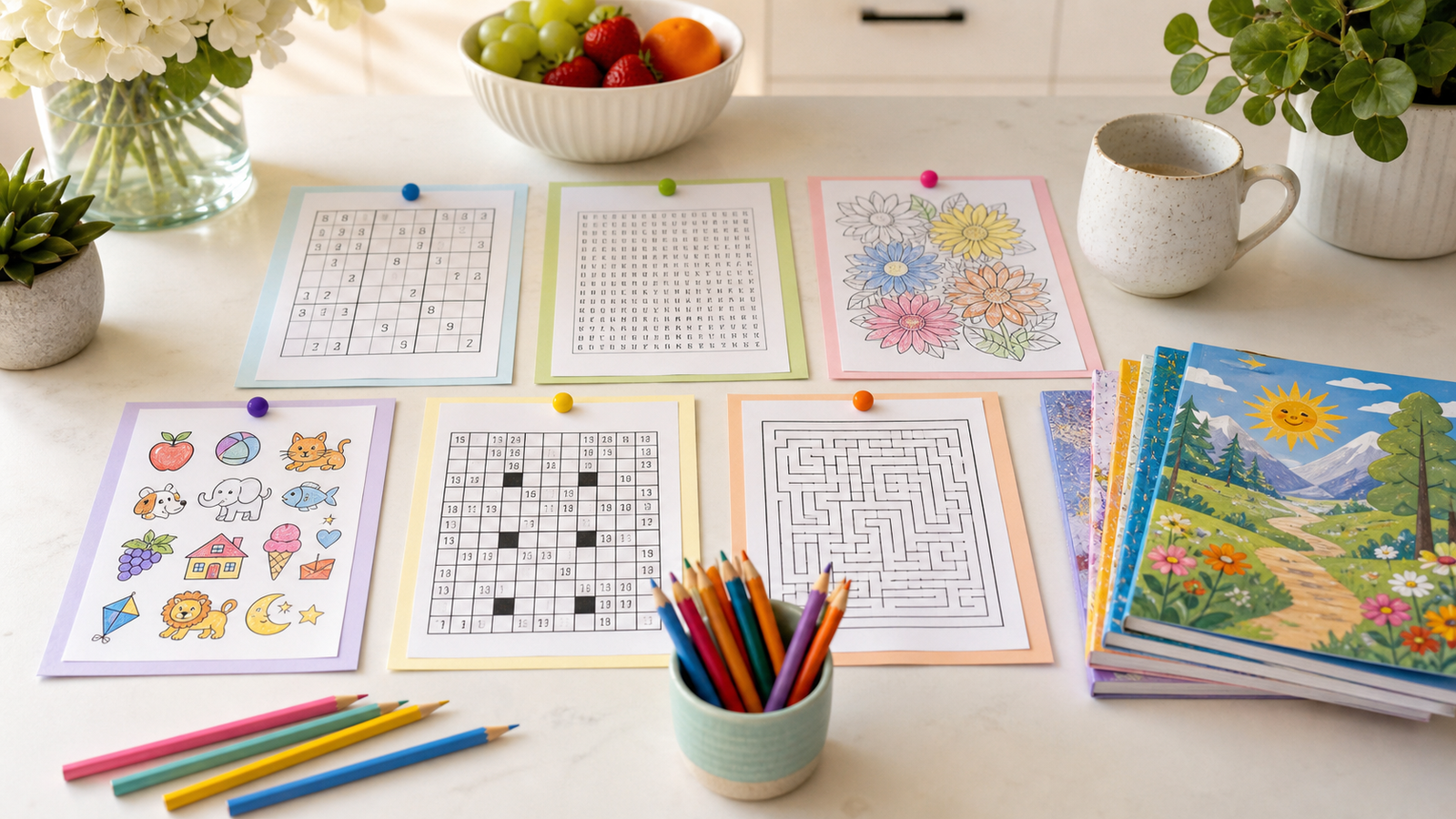
Put a low-friction puzzle kit where the current screen habit lives: kitchen table, couch side table, office desk, bedside table, porch chair, or car glove box.
Include one of each.
A coloring page for the youngest.
A word search page for the oldest.
One Sudoku page for the number-focused.
One large-print page for grandparents.
One timer.
One pen, one pencil, one eraser.
This does not look glamorous.
That is exactly why it works.
People choose the first behavior they can execute under fatigue.
A page in front of a person is easier than a platform, app, or argument.
The One-Page Setup in under one minute
Step 1: Put phone and tablet away from arm's reach.
Step 2: Put one paper page on the table.
Step 3: Start a 15-minute timer.
Step 4: Pick one action on that page and do it before taking any other screen.
That is it.
The 15-minute window solves the emotional spike when people are tempted to bounce.
If you need a second, this still works if you do 10 minutes.
The one-page rule is deliberately short.
It turns behavior from identity to motion.
Why This Is Easy to Share
People copy what is simple in public.
You only need one photo, one short sentence, and one repeated scene to explain it.
What makes it spread is not performance.
It spreads because the outcome is obvious.
Less arguing.
Less bargaining.
More predictable resets.
A short page can be photographed, taught, and repeated without heavy explanation.
The one-page reset also works because it gives everyone a clean ending.
A page has a finish line.
A maze has an exit.
A word search has ten words circled in the first pass.
A Sudoku grid has one row solved.
A coloring page has one shape filled.
The brain gets permission to stop.
Most digital loops avoid stops.
That is why people feel stuck.
Who this helps the most
Kids need it because they do not know how to negotiate low energy.
Busy adults need it because willpower is not their job after long hours.
Grandparents need it because they often want a gentle activity that stays shared.
Caregivers need it because everyone can play in the same room without being on the same task.
You can run this with toddlers, students, teens, and adults in one rule.
The difference is in the page only, not in the pressure.
Common mistakes that kill the reset
Trying to offer too many tools.
A bigger stack usually means longer negotiation.
Trying to skip the timer.
Without a clear end, the screen reclaims the space.
Trying to force an advanced book.
If the first page is hard, the rule becomes a test.
Trying to make it about willpower.
This is a design problem. Make the paper option easier.
A better version is not perfect behavior.
A better version is visible repetition.
Launch it tonight
Pick one room.
Pick one kit.
Pick one hour window.
Ask for one page before one more screen.
If the room still drifts to a screen after that, reset again.
A better room is built from many tiny resets.
No one needs to be perfect.
People need a practical alternative when the first impulse lands.
PuzzlePlay Books fits this model because it keeps activity options by age and mood.
Adults can use a mandala or Sudoku page.
Kids can use ABC, dinosaur, or maze pages.
Caregivers and grandparents can use large-print word search.
Parents get one visible routine that is easier to repeat than a full detox.
If you want a faster read and a clean start, begin with large-print word search for grandparents and one easy word search for the room.
The one-page reset is not a trend because it is new.
It spreads because it removes a hard choice.
If your household keeps choosing screen because it is easiest, make the table choose better first.
If you need a source-backed version, use the same room plan and swap one page daily.
The room changes when the first object is ready.