
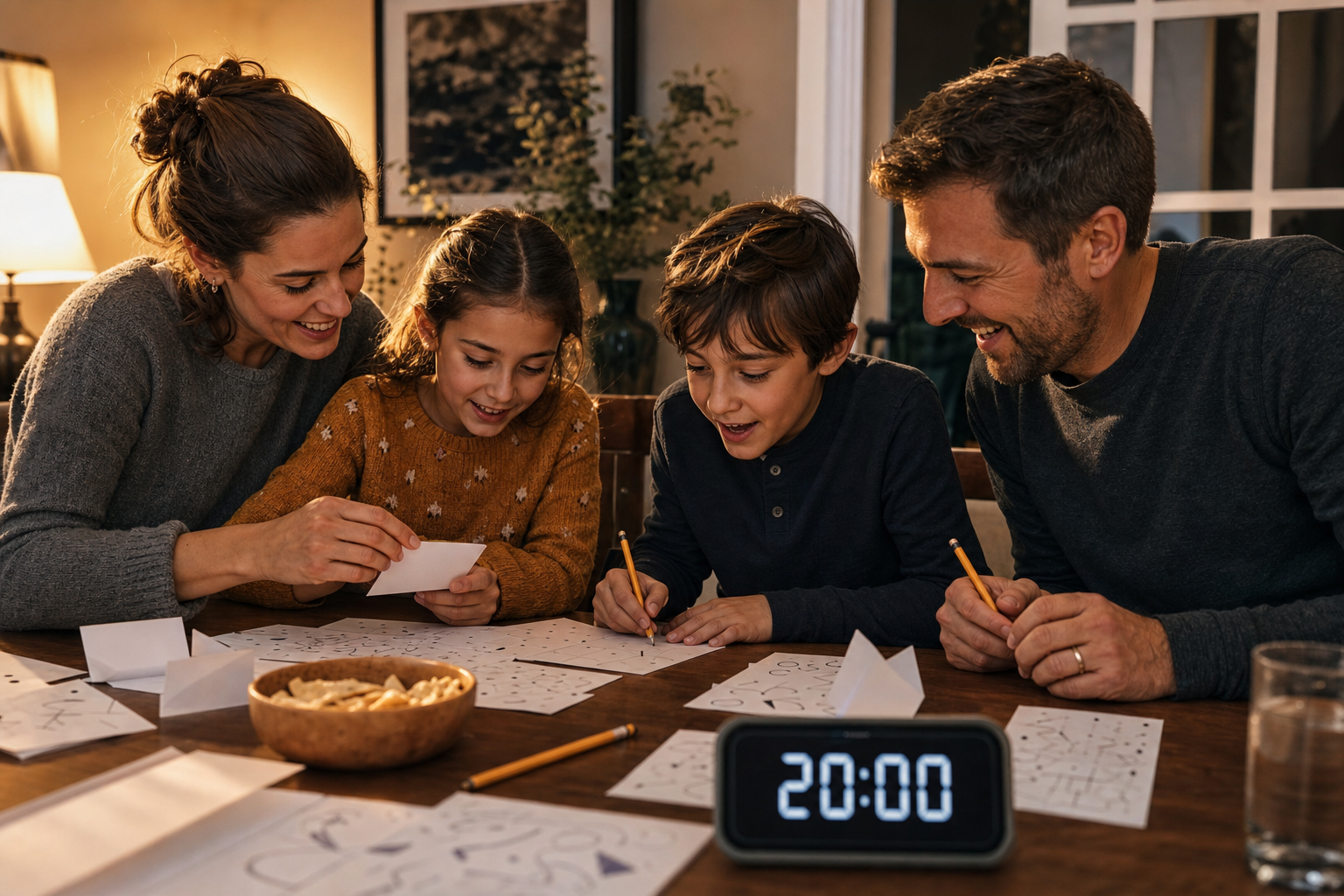


A friendship-themed puzzle pack works because it gives kids and grown-ups something simple to do together right away. One person does not have to carry the whole activity. Two people can share clues, compare answers, pass a pencil back and forth, and finish with the feeling that they solved something as a team instead of just sitting near each other.
The timing is strong right now. The United Nations observes International Day of Friendship on July 30, which makes late July a natural moment for families, camps, classrooms, and libraries to use printables that feel welcoming, cooperative, and easy to start. The American Academy of Pediatrics Family Media Plan tool also fits this topic because many adults want a better default than handing every quiet moment back to a screen. A pencil-first partner page is one of the simplest ways to create that default.
That is why this theme works beyond one calendar day. A good friendship packet can help at a summer camp table, a classroom community station, a library family program, a rainy afternoon at home, or a birthday party that needs one calm shared activity before the next louder thing starts.
Why a friendship puzzle pack works especially well
Friendship-themed activities are best when they are light and usable, not heavy or forced.
Printables work best in those in-between moments:
• while one child is ready to start and another is still warming up.
• while a classroom needs a pair activity that does not require devices.
• while camp leaders want one cooperative table that is quieter than a full relay race.
• while a library family event needs something visitors can understand at a glance.
• while siblings, cousins, or friends want one more game without setting up a board game box.
That is why the packet should stay simple. Good friendship pages work with a printer, pencil, clipboard, and table. They should not need scissors, glue, wifi, or a long speech about teamwork before anyone can begin.
What makes a good printable friendship packet
The best packet is not the busiest packet. It is the one people can print quickly and actually use with a partner.
Aim for:
• one clear task per page.
• black-and-white friendly layouts that do not waste ink.
• directions short enough for kids to understand without constant adult rescue.
• tasks that let each partner contribute something visible.
• a mix of fast wins and one or two slightly slower logic pages.
• prompts broad enough to work for friends, siblings, cousins, camp buddies, reading partners, or parent-child pairs.
If one player has all the answers or one page turns into a lecture about being nice, the packet loses its value fast. The real appeal is that both people get a job and the job is fun.
The 15 printable partner games worth building first
1. Friend-name word search
Hide approachable words such as friend, share, laugh, clue, team, puzzle, help, and play. This is an easy opener for mixed ages and mixed confidence levels.
2. Match-my-clue half sheets
Split a page in two. One partner gets pictures and the other gets words or clues. They can only solve the page by talking to each other.
3. Partner maze with split directions
Give one player the maze and the other player the directions. One reads, one traces. Then switch roles on the next round.
4. Mirror pattern strip
Show half of a symbol pattern on one side and ask the pair to complete the other half together. Stars, hearts, pencils, smile faces, or puzzle pieces all work.
5. Compliment code card
Use a simple number key or symbol key to reveal a friendly message such as GREAT JOB, NICE TRY, YOU HELPED, or TEAM WIN. Keep it light and concrete instead of sentimental.
6. Shared scavenger checklist
Use broad prompts such as find something striped, find something blue, find a word with five letters, or find something that starts with S. This works well in classrooms, libraries, camps, and at home.
7. A=1 team codebreaker
Use a basic number key to reveal words such as TEAM, SHARE, PAIR, PAL, or FRIEND. This adds challenge without adding supplies.
8. Draw-what-I-describe mini page
One partner describes a simple picture using shape words, position words, or counting clues while the other draws it. Then compare and switch.
9. Friendship category sort
Give players a short list of words and ask them to sort each one into groups such as things you say, things you share, places you meet, or games you play. This adds a reasoning step without becoming preachy.
10. Turn-taking bingo strip
Use simple prompts such as ask a question, solve one clue together, switch pencils, spot the matching icon, or finish a row. The page feels active without needing a whole room setup.
11. One-letter team ladder
Build a short word ladder such as PLAY to CLAY or TEAM to TEAL with one-letter changes. This gives older solvers a stronger word challenge without extra materials.
12. Mini buddy logic puzzle
Use three kids, three snacks, and three activity cards with a few clues. Keep it short enough to solve in under three minutes so it feels satisfying instead of heavy.
13. Spot-the-difference pair page
Show two simple scenes with a few changed details such as one extra star, missing pencil, or swapped puzzle piece. One player circles while the other keeps count.
14. About-my-partner prompt card
Give players a few short lines to write one thing their partner noticed, one clue they solved, and one part they want to try next. This keeps the packet from becoming only grids and mazes.
15. Final friendship password
Let answers from earlier pages supply letters for one last word such as SHARE, TEAM, HELLO, TRUST, or FRIEND. This is the page that makes the whole packet feel complete.
Three ready-to-use mini examples
These are simple enough to build before the next family night, camp block, or classroom station.
Example 1: quick riddle
Clue: We solve better together, but we are not a giant machine. What are we? Answer: a team.
Example 2: tiny codebreaker
Use A=1, B=2, C=3.
16 - 1 - 9 - 18
Answer: PAIR.
Example 3: mini logic clue
Maya, Theo, and June each solved one page first: maze, codebreaker, and word search.
• Maya did not solve the maze first.
• Theo did not solve the codebreaker first.
• June did not solve the word search first.
Answer: Maya solved the word search first, Theo solved the maze first, and June solved the codebreaker first.
How to package it for families, teachers, and activity buyers
A strong friendship packet usually needs only six to ten pages.
Start with:
• 2 quick word, match, or pattern pages.
• 2 talk-and-solve pages such as split clues or draw-and-describe prompts.
• 2 logic or code pages.
• 1 short reflection or writing page.
• 1 final password page.
• 1 answer key.
That mix is enough for a classroom pair station, library family program, camp quiet block, or family-night folder without making the packet feel bulky.
Family and at-home version
For families, start with the word search, split-clue page, and spot-the-difference page at the kitchen table or during a rainy afternoon reset. Save the logic page, prompt card, and final password for later in the day. That pacing keeps the packet useful instead of burning through every page at once.
Because the structure is cooperative, it also works well for mixed ages. A younger child can trace, circle, count, or notice details while an older child or adult handles reading clues and checking answers. Both still get to participate.
Classroom, camp, library, and homeschool version
For teachers, librarians, homeschool planners, and camp leaders, this theme works well for partner warmups, welcome-week tables, rainy-day cabin activities, library family events, and low-prep community builders. Use the split-clue page, one codebreaker, the draw-and-describe prompt, and the final password page as short stations, then keep the answer key nearby so the activity stays self-directed.
Because the pages are broad, they still work after International Day of Friendship passes. Kids can use the same packet for partner reading, family night, classroom table teams, cousins on vacation, or a birthday party that needs one screen-light activity before snacks.
Fast answers to common buyer questions
What ages work best for friendship printables?
Most friendship-themed printable packs work best for ages 5 and up, with easier match, count, and pattern pages for younger solvers and logic or code pages for older kids, tweens, and mixed-age family groups.
What supplies should the packet assume?
Assume only a printer, pencil, and optional clipboard or folder. If a page needs markers, scissors, glue, or internet access to function, make that obvious before anyone prints it.
Do these pages only work for best friends?
No. The same packet can work for classmates, siblings, cousins, camp buddies, parent-child pairs, library visitors, or any two people sharing a short activity.
How long should a partner puzzle session last?
Ten to twenty-five minutes is usually enough for a table rotation, family-night block, camp quiet period, or after-lunch reset. Shorter sessions are often easier to repeat than one long packet marathon.
Common mistakes to avoid
Do not make one partner passive while the other does all the work.
Do not use tiny type or cramped answer spaces that fail on laps, clipboards, or crowded tables.
Do not turn every page into a moral lesson. The packet works better when the cooperative structure does the teaching quietly.
Do not forget the answer key. Fast checking makes partner activities easier to run in real classrooms, camps, libraries, and homes.
Internal link suggestions
Pair this topic with the Printable Puzzle Relay Team Game, the National Night Out Puzzle Pack, the Back-to-School Printable Puzzle Hunt, the free puzzles and games page, and the Kids Coloring Playroom. Readers who like this theme often want another printable-friendly activity for the next family night, camp table, or classroom station.
Call to action
Want more printable-style puzzle ideas that work on real tables, with real partners, and inside real family schedules? Browse PuzzlePlay Books for family-friendly puzzle guides, classroom-ready printables, and practical screen-light activities that are easy to print and easy to reuse.