

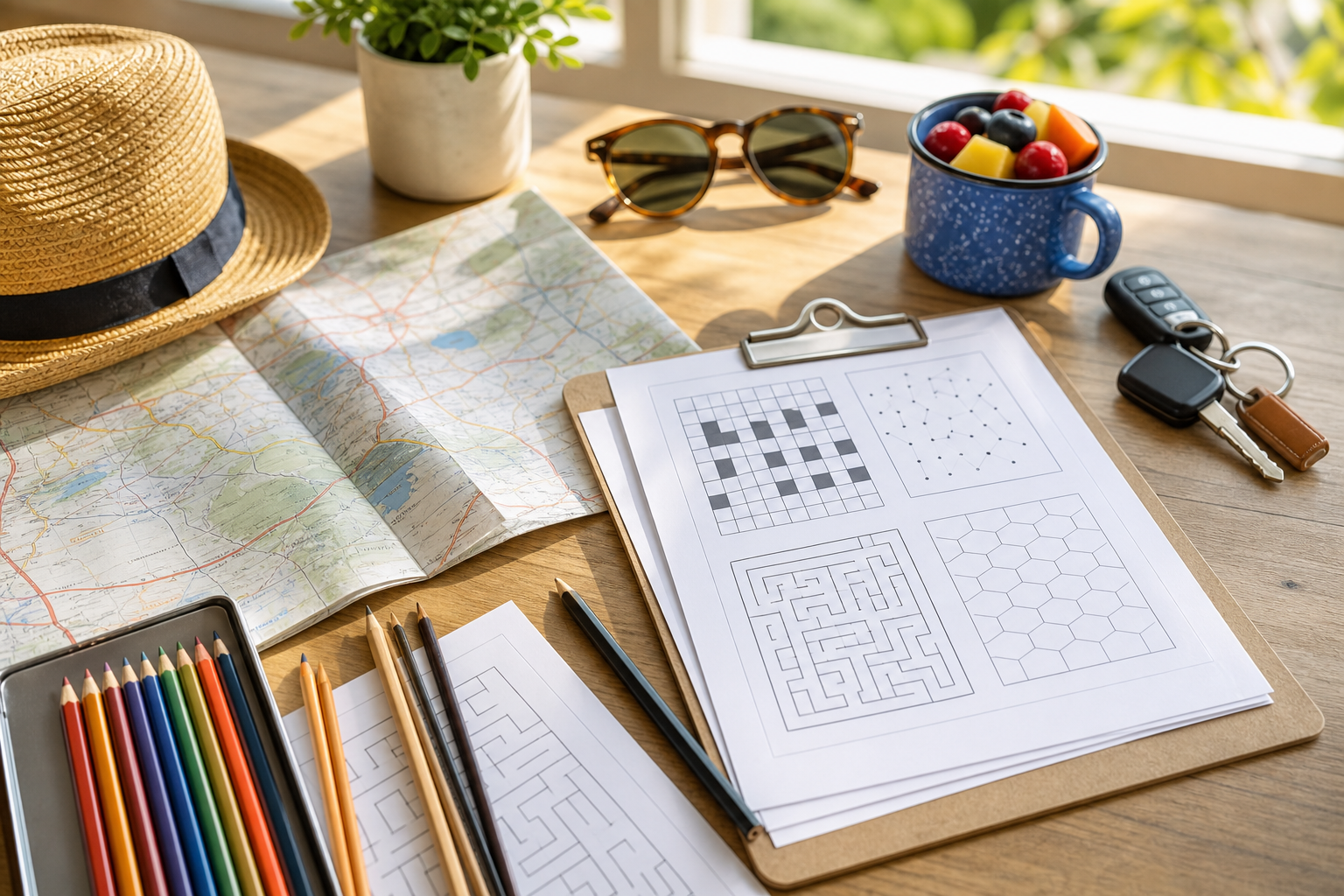


A hotel room is supposed to be the easy part of a trip, but real travel days keep creating small waiting windows that feel longer than they look. The room is not ready yet. One child wants to swim and another needs a calmer table activity first. A thunderstorm changes the afternoon. Dinner is still an hour away. Everyone is tired, but nobody is ready to sleep. That is where a hotel quiet-time puzzle pack earns its place.
The timing is practical right now. The Transportation Security Administration keeps a live passenger-volumes page because family travel remains busy during peak travel seasons, the National Weather Service heat-safety resources are a reminder that hot afternoons often push families indoors, and the American Academy of Pediatrics Family Media Plan gives families a way to decide ahead of time what a screen-light backup can look like when the day slows down. In practical terms, late July and early August are full of trips, weather pivots, and hotel downtime that goes better with a pencil-first option already packed.
That is why this kind of printable works. It is quiet, low prep, easy to pause, and simple to hand across a bed, small table, breakfast nook, lobby chair, or vacation-rental counter without needing wifi, chargers, or a long explanation.
One important note first: these pages work best during seated, supervised downtime such as room-rest windows, lobby waits, breakfast-table starts, weather holds, and evening wind-downs. They are not for balconies, elevator rides, pool-deck walking, parking lots, luggage carts, or any moment when kids need full attention on moving safely through a shared space.
Why a hotel quiet-time puzzle pack works
Hotel downtime rarely arrives as one perfect block. It comes in pieces.
Printables help most in moments like these:
• while one adult checks in and another needs a calm activity ready right away.
• while a room, rental, or meal plan is running later than expected.
• while the hottest part of the afternoon or a weather delay pushes the day indoors.
• while siblings need the same quiet mood without the exact same difficulty.
• while families want an easy evening reset that does not automatically become another hour on a device.
That is also why the packet should stay simple. Good hotel pages should work with a printer, pencil, clipboard, tray table, or hotel desk. They should not depend on scissors, glue, a stable internet connection, or a big workspace before anyone can begin.
What makes a good printable hotel packet
The best packet is not the biggest packet. It is the one a family actually uses after luggage is dropped and the trip rhythm changes again.
Aim for:
• one clear task per page.
• black-and-white friendly layouts that do not waste ink or require a color printer.
• large answer spaces that still work on laps, clipboards, hotel desks, and small breakfast tables.
• pages that can pause instantly if someone knocks, dinner arrives, or the weather clears.
• a mix of quick visual wins and slightly slower logic pages for older solvers.
• prompts tied to real travel moments such as room numbers, maps, elevators, snack runs, suitcases, and quiet-hour routines.
If a printable depends on tiny cut-apart pieces, one exact property layout, or a long script before the first answer makes sense, it is probably the wrong hotel printable. Good travel pages survive interruption.
The 15 printable travel games worth building first
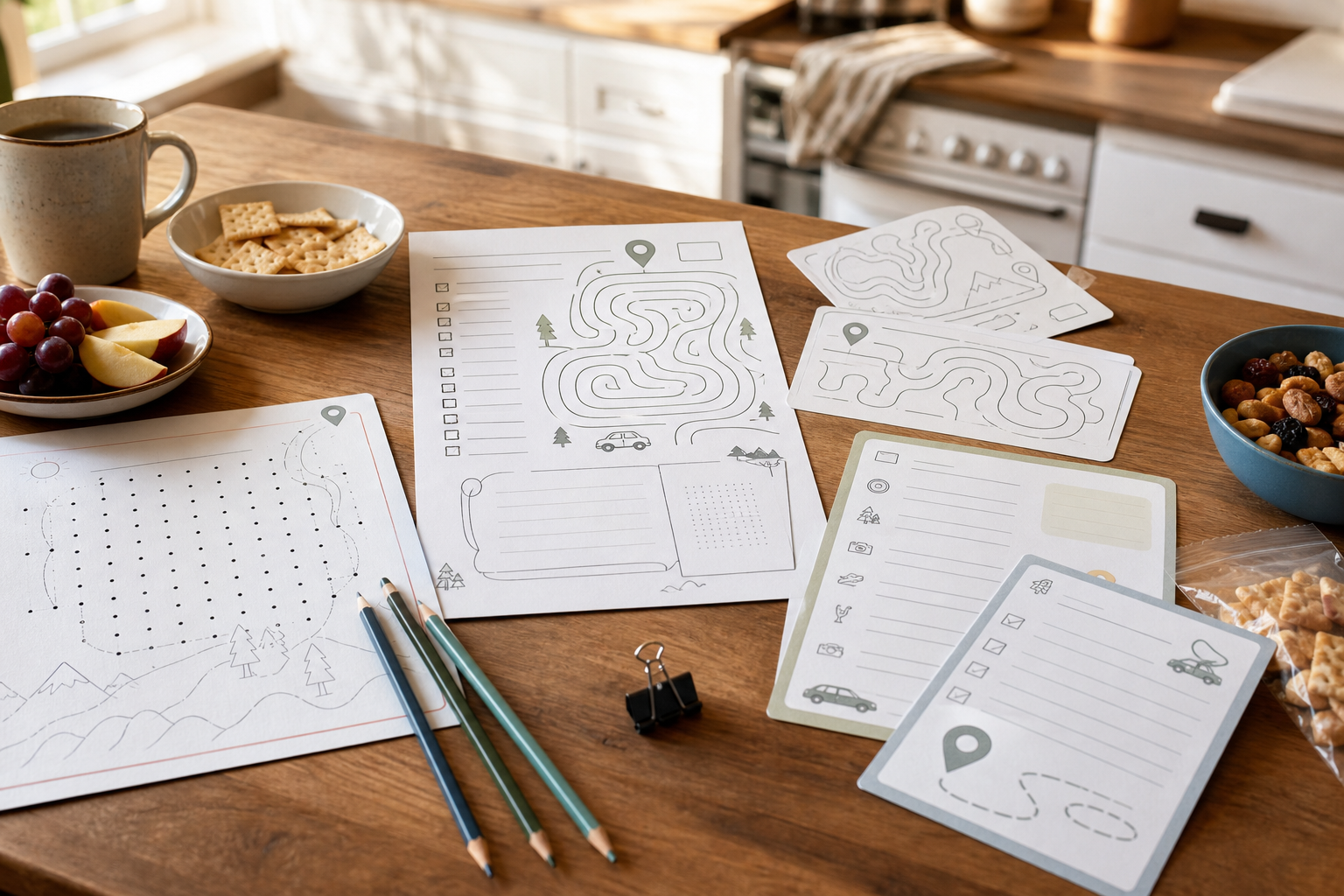
1. Key-card word search
Hide approachable words such as room, key, pool, map, snack, lobby, towel, and trip. This is an easy opener for mixed ages and tired travelers.
2. Room-number maze
Draw a simple path from the lobby to the correct room number without crossing blocked squares. A short maze feels finishable even when attention is low.
3. Suitcase checklist scramble
Turn practical words such as charger, socks, book, pencil, pajamas, and toothbrush into a scramble or match page. This keeps the printable connected to the real trip.
4. Hotel icon match page
Use broad symbols such as bed, suitcase, elevator, key card, towel, and breakfast tray. Players can match pairs, circle the odd one out, or connect each icon to its word.
5. Elevator-button pattern strip
Alternate numbers, arrows, or simple travel icons in a visible pattern, then add a slightly harder version underneath. This gives younger solvers a quick win.
6. Breakfast-buffet category sort
List broad clues such as fruit, plate, waffle, napkin, juice, spoon, and cereal, then ask players to sort them into categories such as food, tools, and table items. Keep the prompts broad enough that the page still works beyond one exact hotel.
7. Map-to-pool coordinate clue
Build a tiny pretend map with labeled squares for room, elevator, lobby, breakfast room, and pool. Players decode clues such as B3 or C2 to find the next symbol or letter.
8. Quiet-hour spot-the-difference
Show two similar travel scenes with a few changed details such as a towel, snack bag, book, or suitcase tag. This is easy to explain and easy to pause.
9. One-letter travel word ladder
Build a small ladder such as ROOM to ROOF or TRIP to GRIP with one-letter changes. This gives older solvers a stronger challenge without extra supplies.
10. Vacation-postcard rebus
Use simple pictures and letters to clue words such as BEACH, CABIN, MAP, SNACK, or NIGHT. Rebus pages work well when reading levels vary.
11. Mini check-in logic puzzle
Use three travelers, three snack picks, and three room numbers with a few clues. Keep it short enough to solve in under three minutes so it feels satisfying instead of heavy.
12. Weather-hold codebreaker
Use A=1 or a simple picture key to reveal words such as SHADE, INSIDE, LOBBY, REST, or READY. This is easy to print before the trip and easy to reuse during a changed plan.
13. Packing tally card
Scatter travel icons such as socks, books, stars, keys, bottles, and bags around the page. Ask players to count and compare totals, then name the most common symbol.
14. Family memory prompt
Give players three short lines to name one thing they noticed today, one puzzle they want next, and one place they still want to visit on the trip. This keeps the packet from becoming only mazes and grids.
15. Final ROOM password page
Let answers from earlier pages reveal one letter each so the packet ends with ROOM, TRIP, REST, or STAY. A final password gives the folder a sense of finish without making it feel heavy.
Three ready-to-use mini examples
These are simple enough to build before the next travel weekend or hotel check-in.
Example 1: quick riddle
Clue: I open the room, but I am not the door. What am I? Answer: the key card.
Example 2: tiny codebreaker
Use A=1, B=2, C=3.
18 - 15 - 15 - 13
Answer: ROOM.
Example 3: mini logic clue
Maya, Theo, and June each picked one page: maze, rebus, and codebreaker.
• Maya did not pick the maze.
• Theo did not pick the codebreaker.
• June did not pick the rebus page.
Answer: Maya picked the codebreaker, Theo picked the rebus page, and June picked the maze.
How to package it for families, teachers, and activity buyers
A strong hotel quiet-time packet usually needs only six to ten pages.
Start with:
• 2 quick word, match, or pattern pages.
• 2 observation or checklist pages.
• 2 logic or code pages.
• 1 short writing or draw-and-tell page.
• 1 final password page.
• 1 answer key.
That mix is enough for a hotel folder, vacation-rental drawer, carry-on pouch, camp cabin table, or travel-theme library station without making the packet feel bulky.
A short reusable folder also makes it easier to stay intentional about screens. The AAP Family Media Plan is useful here because the same idea applies on the road: decide ahead of time what the default will be when a trip slows down unexpectedly. If one or two pages are already clipped together, adults do not have to improvise every time the room gets noisy or the weather changes.
Family travel-day, classroom, and library version
For families, start with the word search, icon page, and tally card while everyone is settling into the room. Save the logic puzzle, codebreaker, and final password for the late-afternoon indoor break or the evening quiet block.
For teachers, librarians, and homeschool planners, this theme works well for travel-week stations, geography units, rainy-day vacation tables, and summer reading programs that want one more transportation-friendly printable. Use the coordinate clue, category sort, one codebreaker, and the final password as short stations, then keep the answer key nearby so the activity stays self-directed.
Because the theme is broad, it also works after the trip. Kids can use the same pages to talk about maps, routines, observations, packing, and travel vocabulary without needing to be in a hotel that day.
Fast answers to common buyer questions
What ages work best for hotel quiet-time printables?
Most packs work best for ages 5 and up, with easier matching, maze, and pattern pages for younger kids and logic or code pages for older kids, tweens, and mixed-age family groups.
What supplies should the packet assume?
Assume only a printer, pencil, and optional clipboard or folder. If a page needs markers, scissors, glue, or device access to function, make that obvious before anyone prints it.
How long should a hotel puzzle session last?
Ten to twenty minutes is usually enough for a room-ready wait, a weather hold, a quiet-hour reset, a breakfast-table block, or the part of the evening before the next outing. Shorter sessions are easier to repeat than one long packet marathon.
Do these pages only work in hotels?
No. The same packet can work in vacation rentals, cabins, camp lodges, road-trip meal stops, rainy-day travel breaks, or classroom travel-theme bins.
Common mistakes to avoid
Do not build every page around one exact hotel layout or one exact amenity list.
Do not use tiny type or cramped answer spaces that fail on a lap or small table.
Do not assume the packet should fill every minute of a trip. The real value is that it gives families one easy option when the day slows down.
Do not forget the real-world context. Kids may be tired, hungry, sharing supplies, or pausing for a weather change, so the printable has to survive interruption.
Internal link suggestions
Pair this topic with the Road Trip Puzzle Pack, the Airport Layover Puzzle Pack, the Rainy Day Puzzle Pack, the Pool Day Puzzle Pack, the Printable Puzzle Passport guide, and the free puzzles and games page. Readers who like this theme often want one more printable-friendly activity for the next leg of the trip or the next indoor reset.
Call to action
Want more printable-style travel and family puzzle ideas that work on real tables, in real cars, and in real waiting windows? Browse PuzzlePlay Books for family-friendly puzzle guides, road-trip games, and practical screen-light activities that are easy to print and easy to reuse.