
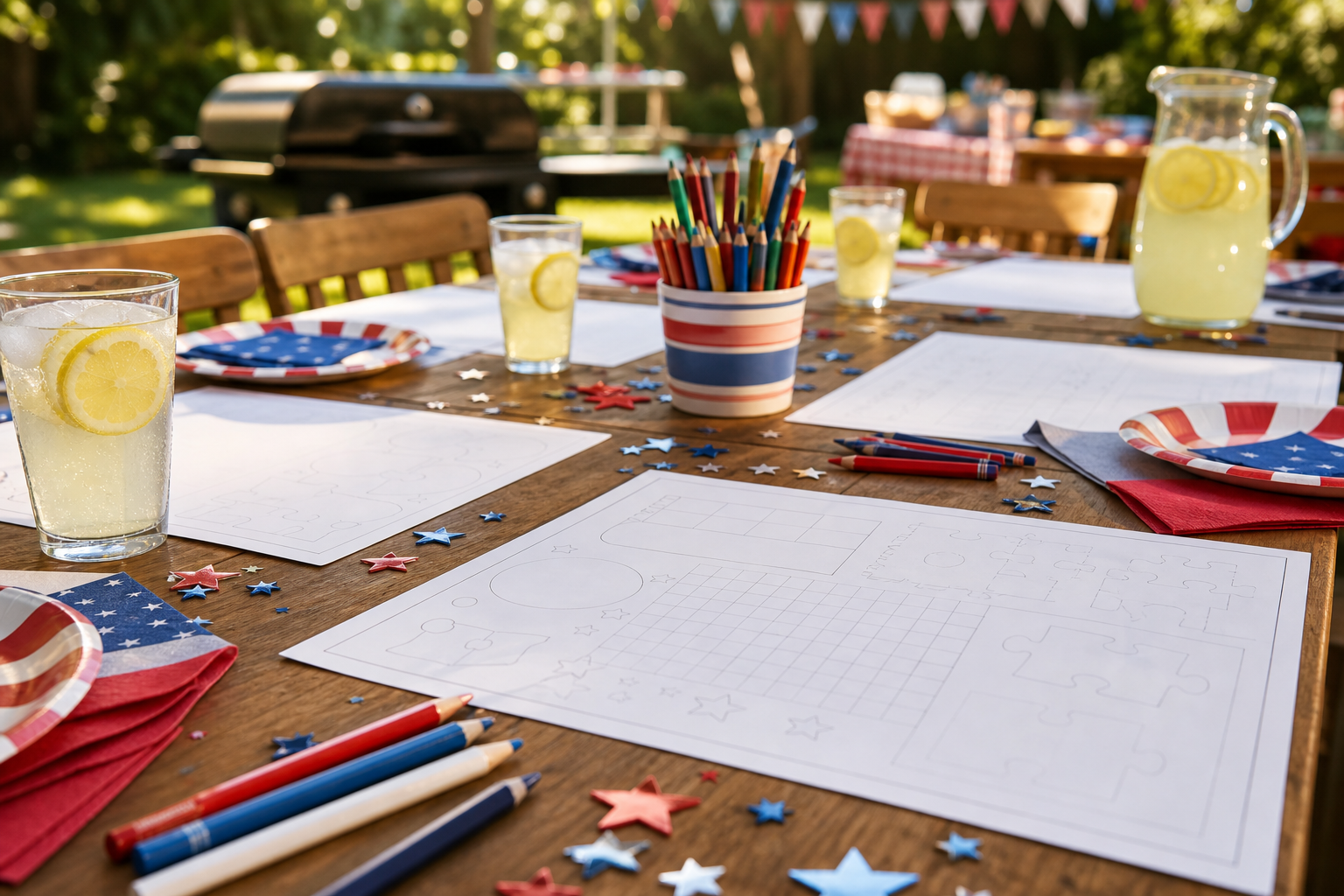


A good Fourth of July printable does more than keep kids busy for five minutes. It gives the table a shared activity, lets mixed ages participate without another app, and turns waiting time into something parents can actually leave out beside plates, crayons, or picnic snacks.
Holiday activity placemats work because families already understand quick word games, category puzzles, and visual brain teasers. The most useful version is practical, table-ready, original, and easy to print again for another gathering.
Why a Holiday Puzzle Placemat Works
A placemat beats a loose puzzle stack because it has a job. It sits where the child already is, it does not require rules explanation, and it can be solved in tiny pieces while adults finish cooking, teachers reset a station, or relatives arrive.
The best version is not a full workbook page. It is a sampler. Each zone should feel like a small win: circle six words, draw one route, crack one code, count one group of stars, or answer one table-talk riddle. That makes it friendlier for younger kids and less embarrassing for older kids who only want to do the hardest corner.
Quick Build: The 9 Puzzle Zones
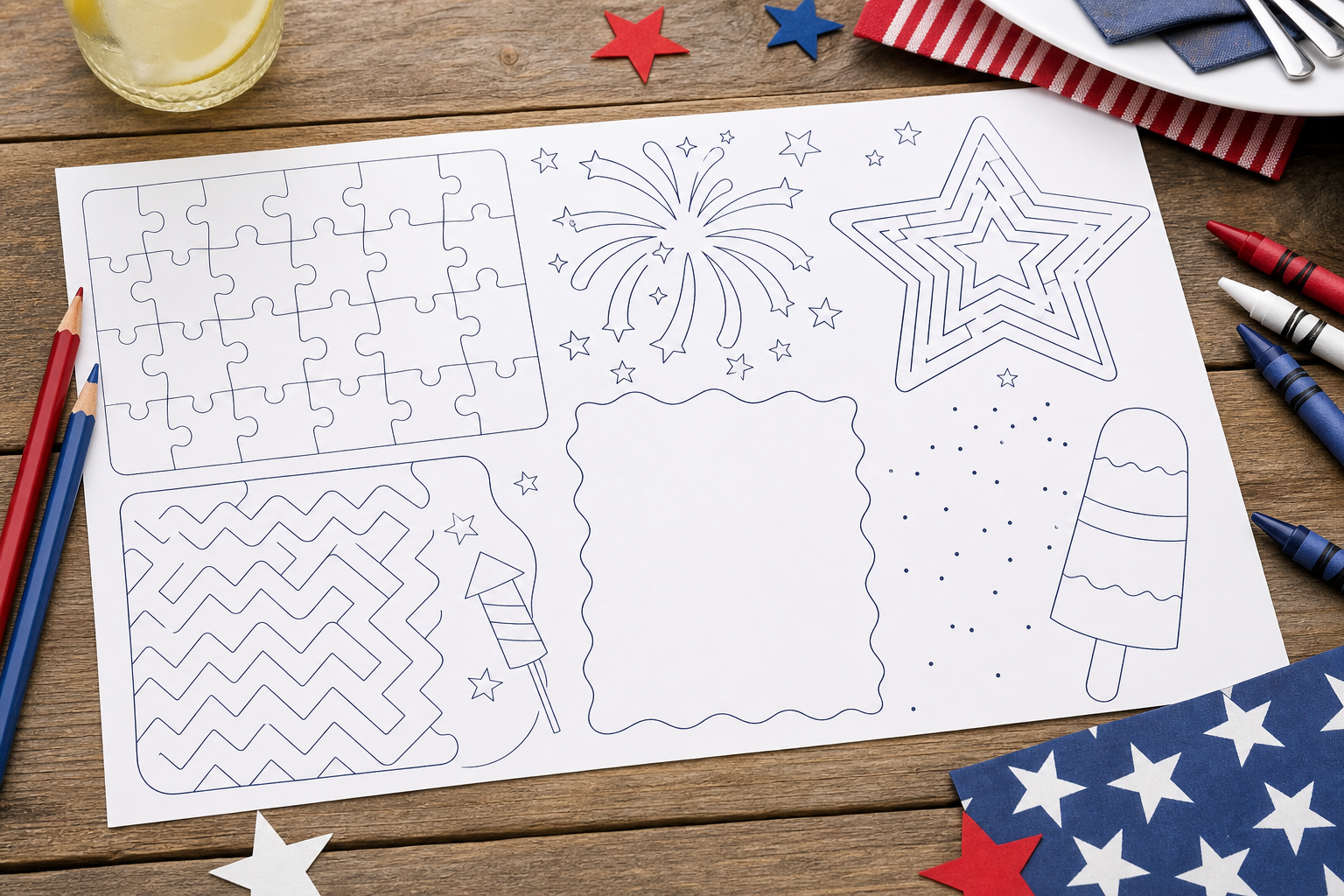
Start with a landscape page and divide it into nine zones. Put the easiest puzzle in the upper left, the most visual puzzle in the center, and the hardest puzzle in the lower right so kids can choose their own path.
1. Star Search Word Grid. Use a 9-by-9 or 10-by-10 word search with holiday-neutral words such as star, flag, picnic, parade, spark, grill, family, summer, red, white, and blue. Keep diagonal words optional for younger solvers.
2. Firework Trail Maze. Draw a simple path from a picnic basket to a sky full of stars. Add three dead ends with tiny icons so the maze looks playful without becoming frustrating.
3. I-Spy Count Box. Scatter stars, stripes, lemons, sunglasses, kites, and paper flags. Ask kids to count two easy objects and one trickier object hidden near the border.
4. Secret Code Message. Assign numbers or symbols to letters and hide a short message like “bring a pencil” or “find the blue star.” Keep the answer wholesome and table-safe.
5. Mini Logic Clue. Give three friends, three snacks, and three picnic blankets. Use two clues, not six. Example: “Ava did not choose lemonade. The red blanket has watermelon.” Kids should be able to solve it in under three minutes.
6. Category Sort Corner. List 12 words and ask solvers to sort them into three groups of four: picnic foods, summer objects, and parade sounds. This borrows the satisfying feel of modern category puzzles while staying original and printable.
7. Finish-the-Pattern Strip. Alternate simple icons such as star, star, stripe, star, star, stripe. Then add one harder pattern for older kids underneath.
8. Table-Talk Riddle. Use a clean riddle that invites family discussion. Example: “I wave without hands and have stripes but no sleeves. What am I?” The answer is flag.
9. Draw-the-Finale Box. Leave one open square that says to draw a new firework shape, picnic badge, or parade float. This gives early finishers something calm to do without needing another sheet.
Use It at a Cookout, Camp, or Classroom Table
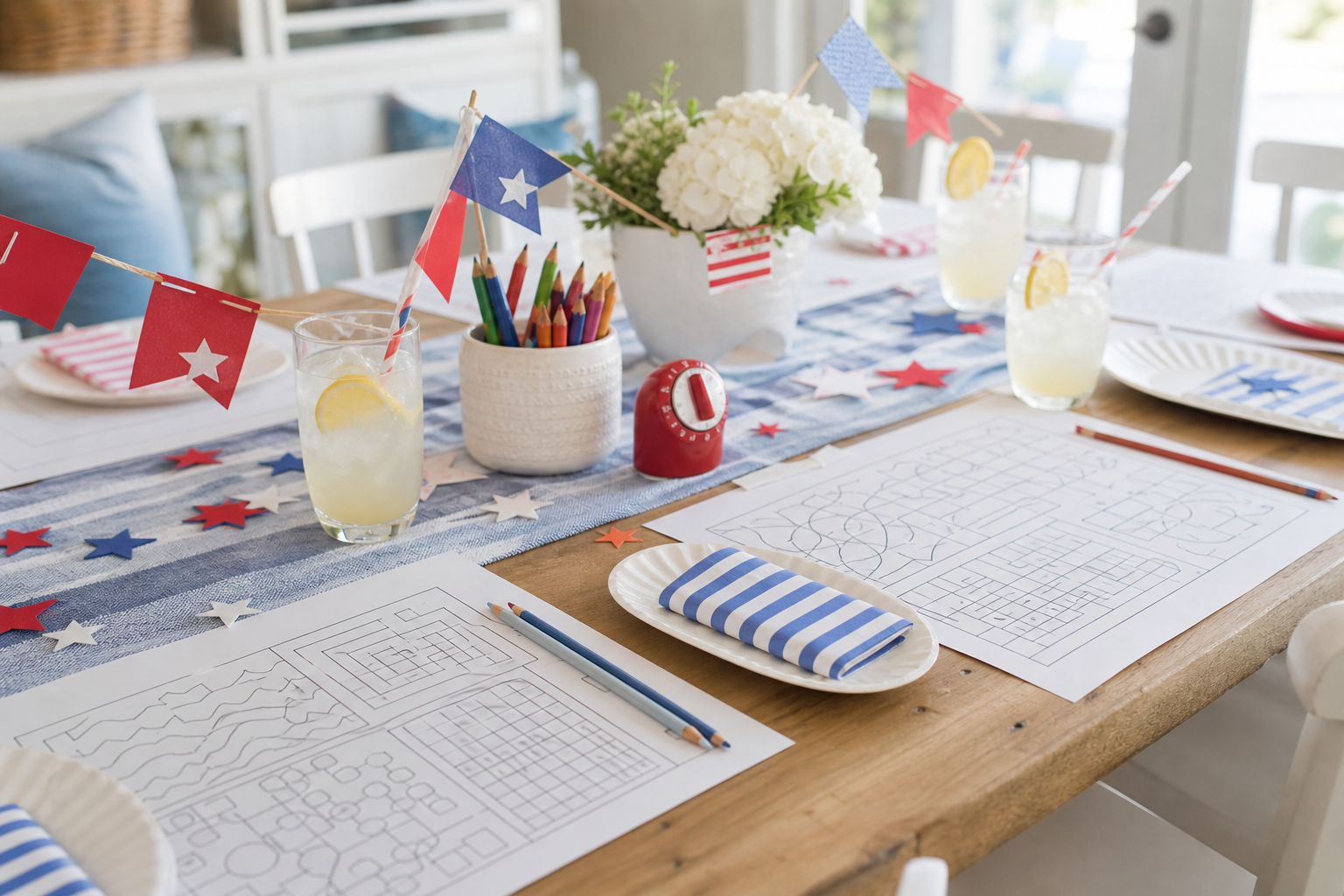
For a cookout, print one placemat per child and place pencils in a cup at the center of the table. Do not announce it like homework. Let the page sit there as an invitation. Adults can join by solving one corner out loud or asking kids which zone was easiest.
For summer camp, laminate three copies and use dry-erase markers. Put the placemat at a rotation station with a two-minute sand timer. When the timer flips, kids initial the zone they finished and move to the next activity.
For classrooms, use it as a pre-holiday bell ringer, indoor recess sheet, early-finisher page, or take-home packet insert. If the class has mixed reading levels, pair readers with nonreaders and make the maze, I-spy, and drawing zones independent.
Age-by-Age Tweaks
Ages 4 to 6 need thick paths, large icons, counting, matching, and drawing. Skip long instructions and make every answer visible on the page.
Ages 7 to 9 can handle the word search, secret code, maze, and simple logic clue. Keep the vocabulary familiar and include one small challenge corner so the sheet does not feel babyish.
Ages 10 and up usually want novelty. Add the category sort, a harder code, or a two-step riddle. Older kids also like making a second placemat for younger cousins, which turns the activity into a creator prompt instead of a worksheet.
Printing and Prep Checklist
Use landscape letter paper for home printers and keep margins generous. A placemat with tiny borders may look good on screen but fail on common printers.
Keep the page mostly black-and-white with small red, white, and blue accents if your audience may print at home. Heavy color backgrounds waste ink and make pencil marks harder to see.
Write instructions inside each zone. If a parent has to explain every square, the placemat is too complicated.
Add an answer key on a separate half sheet for teachers, camp counselors, and parents who want quick checking.
Make the file reusable. One holiday placemat can become a birthday placemat, road-trip restaurant sheet, classroom warm-up, or family game-night starter by swapping the icon set and word bank.
More Screen-Free Puzzle Ideas
Try the Road Trip Puzzle Kit for travel days, Mini Paper Escape Rooms for older kids who want a mission, or 16-Word Category Sort Puzzles for families who like groupable word challenges.
Keep the Table Puzzle-Ready
Want a screen-free table activity that does not need batteries, accounts, or setup time? Start with one printable placemat, then keep a PuzzlePlay Books word search, Sudoku, or kids activity book nearby for the child who asks for “one more puzzle.”