

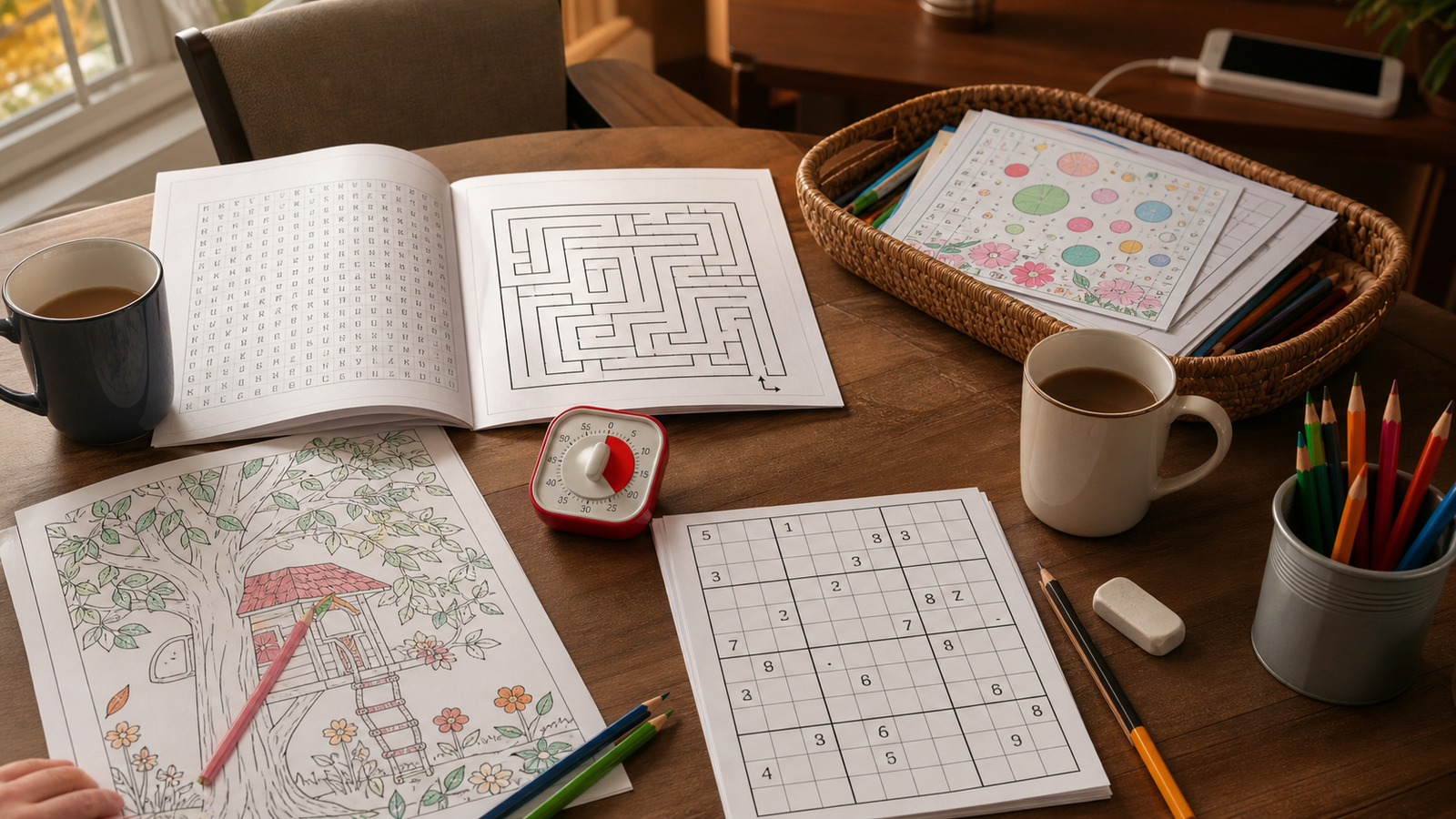


There is a very specific summer moment when the screen spiral starts. It is not bedtime. It is not a big family argument. It is 3:17 p.m., when everyone is a little hot, a little bored, a little hungry, and the easiest sentence in the house is just watch something for a few minutes.
The problem is not that one video exists. The problem is that one video often becomes the family operating system for the rest of the afternoon.
The fix does not need to be dramatic. Try one paper page before one more screen.
Why 3:17 PM Gets Families
Summer afternoons are loose by design. School structure is gone, camps do not cover every gap, parents still have work, and kids hit the bored-but-not-tired zone where every normal activity feels too hard to start.
That is when screens win. They are bright, instant, familiar, and already nearby. A puzzle book in a drawer cannot compete with a tablet on the counter. A coloring page in a folder cannot beat an autoplay feed. The first move matters.
The American Academy of Pediatrics does not frame family media around one perfect minute limit for every home. Its media guidance pushes families to think about the child, the content, calm, what screens crowd out, and how the family communicates. That is useful, but parents still need something practical to do when the room is sliding toward another hour online.
Paper puzzles are practical. They give the child a visible next action: color this corner, find these ten words, trace this maze, solve this row, pick the next pencil.
The Rule: One Page Before One More Screen
The line is simple: one page before one more screen.
It can mean a full coloring page, ten words in a word search, one maze, one Sudoku row, one alphabet activity, one hidden-picture hunt, or one corner of a bigger adult coloring page. The page does not have to be impressive. It only has to interrupt the automatic reach.
This works because it changes the order. Screens can still exist after the reset, but they are no longer the first answer to boredom. A child learns that the first move can be physical, quiet, and finishable.
For adults, the same rule works at night. The American Academy of Sleep Medicine reported that over one-third of adults say bedtime doomscrolling makes their sleep worse. A paper puzzle is not a cure for bad sleep, but it is a cleaner off-ramp than opening a feed when the body needs a slower signal.
The 3:17 PM Setup
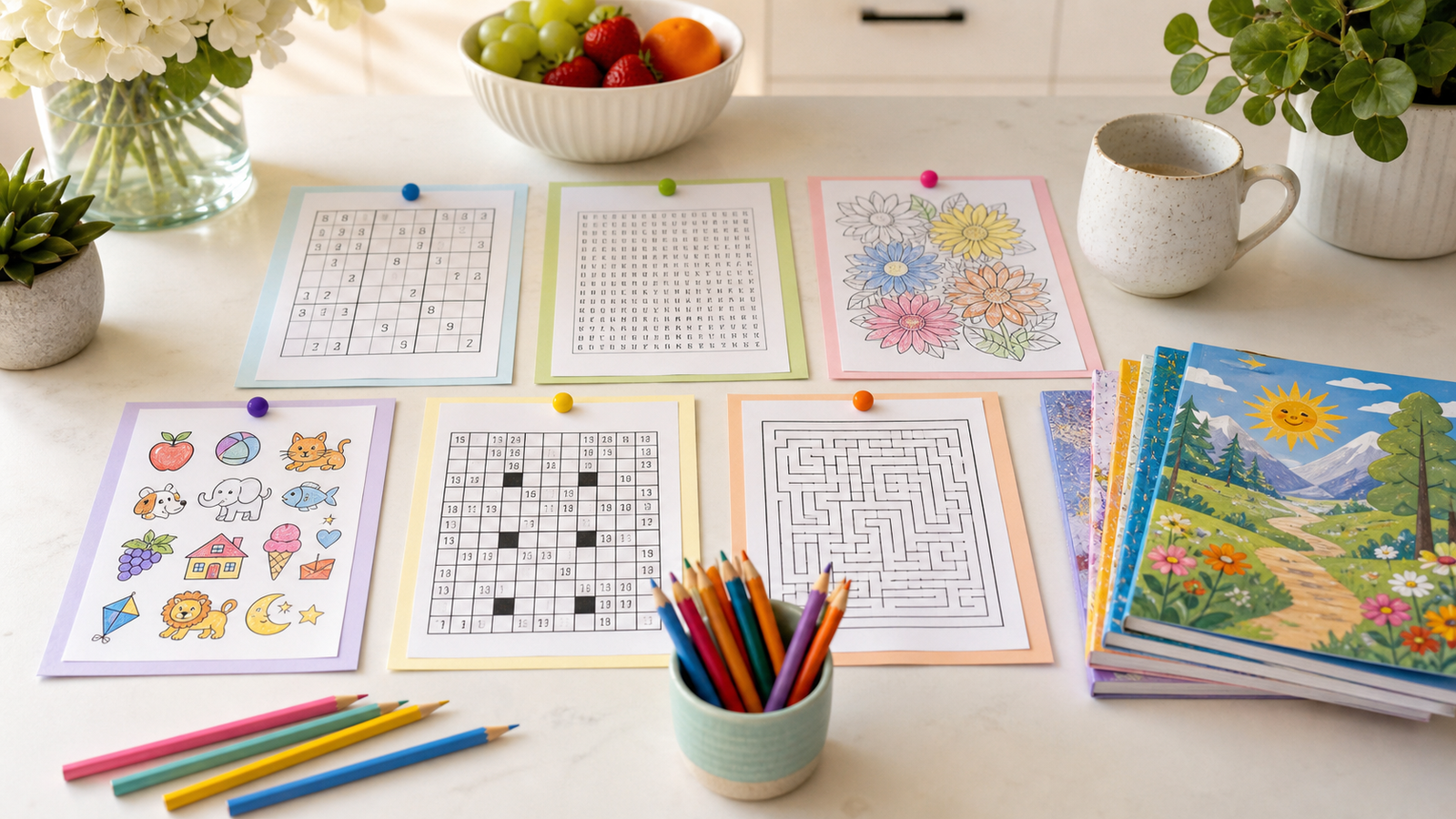
Build the setup before the spiral. Put a small basket where boredom actually happens: kitchen table, coffee table, porch, camper, grandparent bag, car tote, or desk corner.
Add one kids activity book, one word search, one easy Sudoku option, one coloring book, sharpened pencils, colored pencils, a good eraser, and a timer. Keep it almost too simple. If the setup needs a parent to hunt through a closet, the screen wins.
Then move the tablet or phone away from the table. Not as punishment. Just remove it from the first-choice position. Charge it across the room, put it face down, or leave it in another space while the paper option is open.
A 20-Minute Reset That Does Not Feel Like Homework
Set a timer for twenty minutes. Offer two or three choices, not twelve. Too many choices can become another delay tactic.
Say, pick one page for the table. Say, color with me until the timer rings. Say, circle ten words before the next video. Keep the sentence short enough for a tired parent and clear enough for a bored kid.
The reset is allowed to be imperfect. A half-finished maze counts. Ten colored shapes count. One Sudoku row counts. The win is not producing a masterpiece. The win is proving that the first non-screen choice can happen without turning the afternoon into a negotiation.
Why Paper Beats Another App
A good app can be useful, but an app still keeps the child inside the device. Paper changes the room. It puts the activity on the table where siblings, parents, and grandparents can see it. It lets people work beside each other without everyone staring into separate rectangles.
Paper also has a natural stopping point. A word list ends. A maze has an exit. A coloring section is done when it looks done. Digital feeds are designed to keep the next thing arriving before the current thing feels finished.
That is why a paper puzzle basket works better than a lecture. It gives boredom somewhere to go.
What to Put in the Basket
For preschoolers, use ABC coloring pages, thick-line animals, dinosaur pages, ocean themes, simple mazes, and washable tools. For elementary kids, add word searches, harder mazes, hidden pictures, joke prompts, and beginner Sudoku. For adults, add easy Sudoku, adult coloring, word search, or large-print puzzles so the reset becomes a household rhythm instead of a kids-only rule.
For grandparents or caregivers, large print is often the most useful upgrade. Clearer grids and bigger word lists make it easier for everyone to join without the puzzle becoming a squinting contest.
Use The Five Cs Without A Lecture
Child: choose the puzzle for the actual kid in front of you. A dinosaur kid gets dinosaurs. A pattern kid gets coloring. A number kid gets Sudoku.
Content: choose paper content as carefully as screen content. The activity can be calming, funny, creative, social, or challenging.
Calm: use easy pages first. If the house is already tense, do not start with the hardest puzzle in the book.
Crowding out: notice what the screen is replacing. If it is replacing sleep, family talk, outdoor play, reading, or quiet creativity, protect one small part of that space.
Communication: keep the rule repeatable. One page before one more screen.
A Seven-Day Version
Day 1: Put the device away and finish the easiest paper page in the basket.
Day 2: Circle ten words in a word search before any afternoon video.
Day 3: Color one corner of a page and stop before it feels like a chore.
Day 4: Try a maze, then let someone else trace the same path in another color.
Day 5: Solve one easy Sudoku row, box, or full grid depending on the solver.
Day 6: Move the basket to a new place, such as the porch, car, camper, or grandparent bag.
Day 7: Let each person choose next week's paper activity.
The Real Goal
The goal is not a perfect screen-free summer. Perfect is brittle. The goal is a better default.
When the house gets bored at 3:17 p.m., the family should not have to invent a new philosophy. The basket is already there. The page is already open. The pencil is already sharp. One small paper win comes before one more screen.
That is the kind of rule people can actually keep, and the kind simple enough to share.