



Summer screen time gets messy because summer itself gets messy. School routines loosen, the weather changes plans, camps do not cover every hour, and parents still have work, meals, errands, laundry, and their own tired brains to manage.
That is why the best screen-time reset is not a dramatic ban. It is a tiny repeatable trade: twenty minutes of paper before one more video, game, or scroll.
The American Academy of Pediatrics has moved the screen-time conversation away from one perfect minute limit and toward context, content, what screens crowd out, and family communication. That is helpful, but parents still need something concrete to put on the table at 3:17 p.m. when everyone is bored and a tablet is glowing nearby.
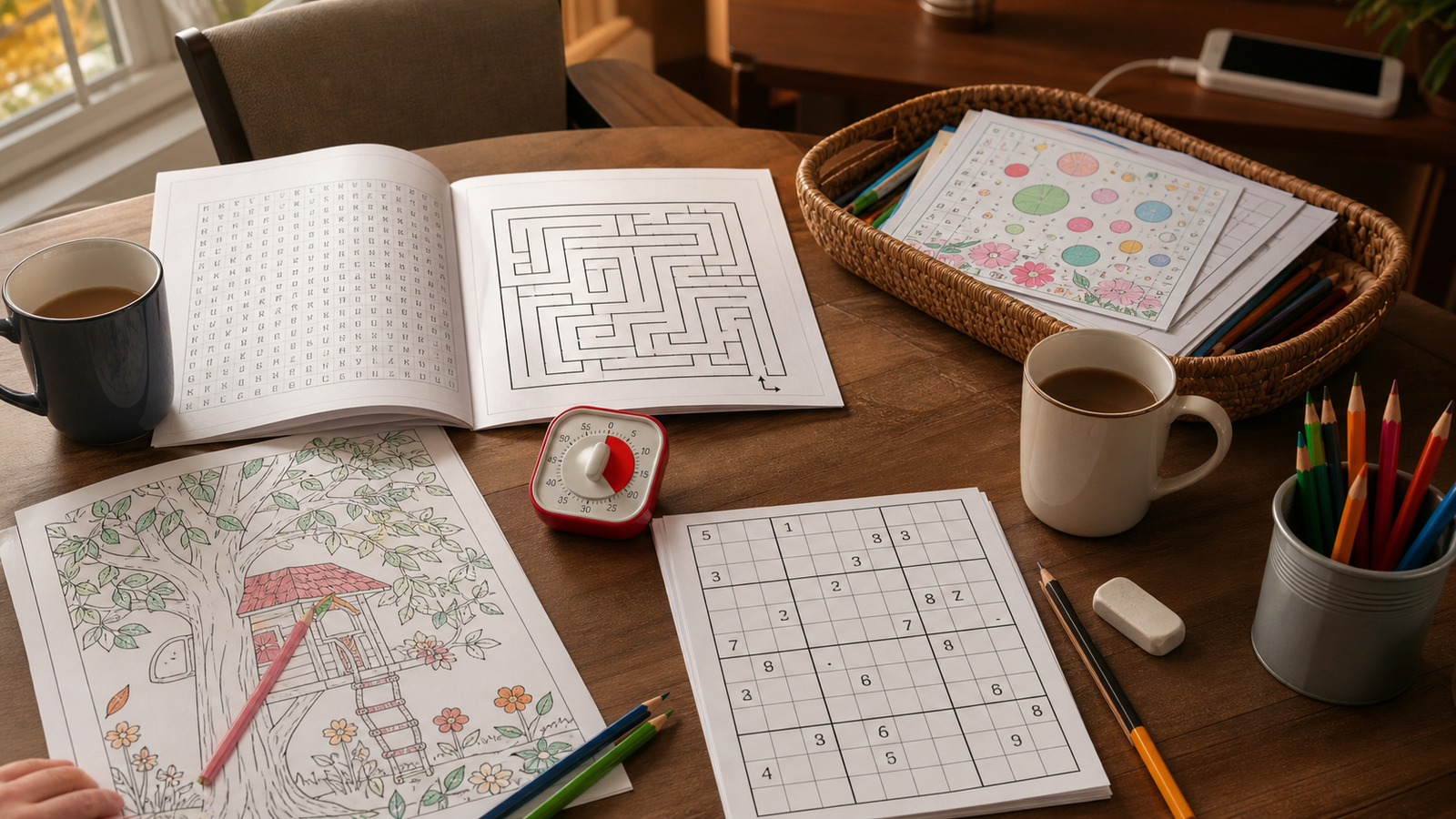
Paper puzzles are concrete. A coloring page, maze, word search, Sudoku grid, or kids activity book gives bored hands something visible to do. It has a beginning. It has an ending. It does not autoplay.
Why Summer Is the Moment
Summer is when families notice their default settings. A child who watched a little after homework may suddenly have long afternoons. A parent who kept screens out of bedrooms during the school year may start bending the rule during travel, heat waves, sick days, or work calls.
That does not make anyone a bad parent. It means the home needs more off-ramps. The AAP Family Media Plan specifically points to summer and holiday breaks as useful times to revisit rules, because routines naturally change. That makes late spring and early summer the right moment to reset the room, not just the rule.
The goal is not to make screens disappear. The goal is to stop the screen from becoming the only easy answer to boredom.
The 20-Minute Reset
Here is the whole plan: put the tablet or phone on a charger away from the table, set a timer for twenty minutes, and offer two or three paper choices. When the timer ends, let the child stop. The win is not finishing a whole book. The win is proving the first non-screen choice can happen without a fight.
For younger kids, use thick-line coloring pages, ABC activity books, dinosaur pages, ocean mazes, hidden pictures, or a simple draw-your-own prompt. For older kids, use word searches, harder mazes, beginner Sudoku, logic puzzles, or a timed family challenge. For adults and seniors, add large-print word search, adult coloring, or Sudoku so the reset feels like a household rhythm rather than a kids-only rule.
Choice matters. Let the child pick the page, pencil color, or first puzzle. That small choice gives ownership without handing over an infinite feed.
What Goes in the Summer Puzzle Basket
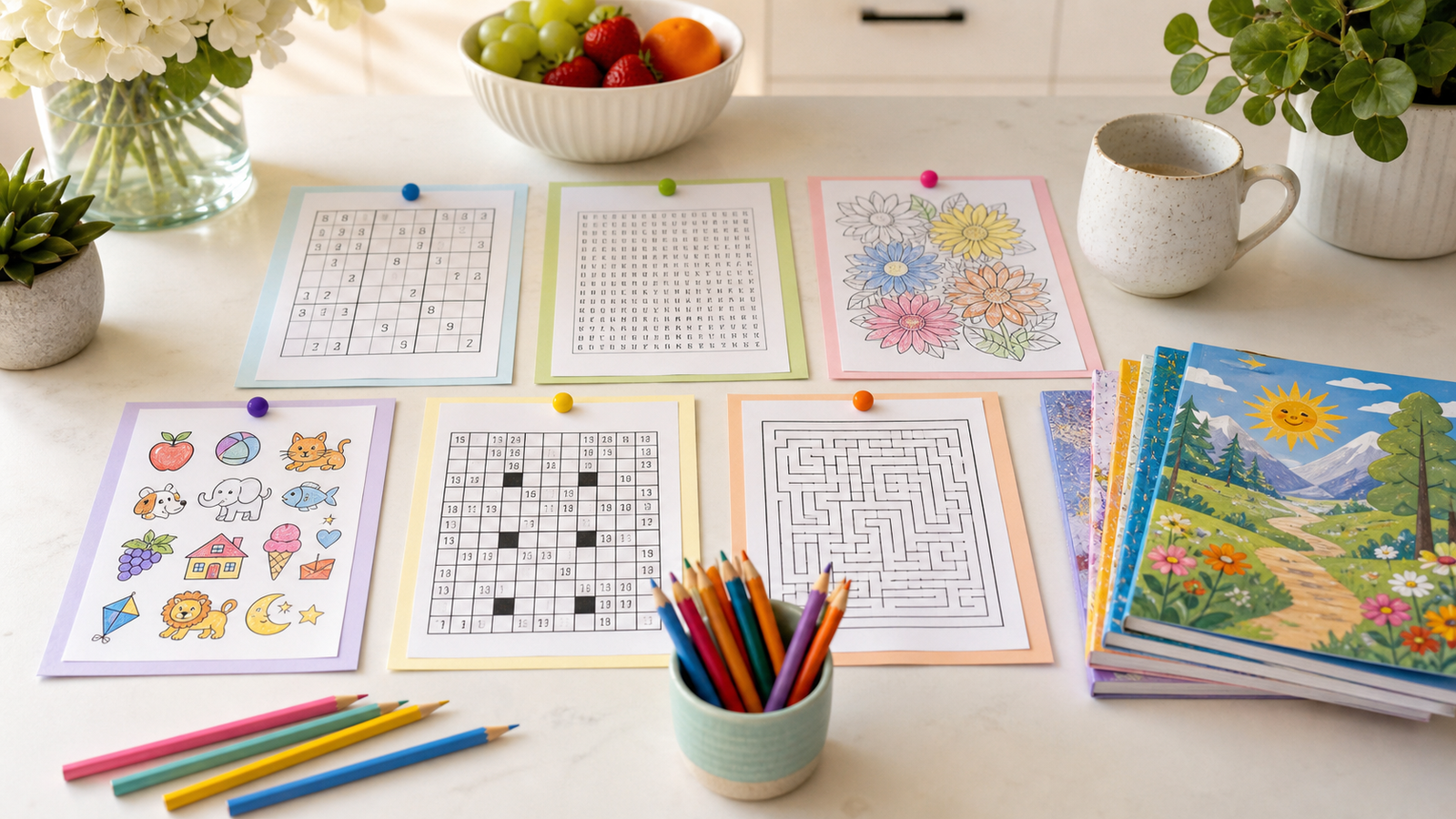
A good basket should look almost too easy. Add sharpened pencils, an eraser, colored pencils, a small sharpener, a few printed coloring pages, one kids activity book, one word search book, and one logic option such as Sudoku or mazes.
Keep it where screen time usually starts: the kitchen table, coffee table, porch, camper, grandparent bag, or car trip tote. If the basket lives in a closet, it will lose. If it lives in the room, it has a chance.
Rotate one item every few days. Novelty helps, but novelty does not have to mean a new device or app. A new dinosaur page, beach word list, travel maze, or silly five-word challenge can be enough.
Use the 5 Cs Without Turning Them Into Homework
The AAP 5 Cs ask families to think about the child, content, calm, crowding out, and communication. A paper puzzle basket fits that framework because it gives parents a replacement activity instead of only a restriction.
Child: choose pages that match the actual child, not the ideal child. A dinosaur kid gets dinosaurs. A pattern kid gets mandalas. A competitive kid gets a timer. A tired kid gets an easy page.
Content: use screen content thoughtfully, then use paper content just as thoughtfully. The right puzzle page can be creative, calming, funny, social, or challenging.
Calm: if the screen has become the only way to settle down, try a paper calm-down menu. Coloring, easy word searches, and simple mazes are better first swaps than hard logic puzzles.
Crowding out: ask what the screen is replacing. If it is crowding out sleep, outdoor play, family meals, quiet reading, or creative time, protect one of those spaces with a paper-first routine.
Communication: keep the language plain. Say, one page before one video. Say, pick a puzzle for the table. Say, color with me until the timer rings. A reset works better when it sounds like an invitation, not a courtroom ruling.
A 7-Day Paper-First Challenge
Day 1: Finish any page for ten minutes. Start small enough that everyone can win.
Day 2: Put a phone face down and circle ten words in a word search.
Day 3: Color one corner of a page. Stop before it feels like a chore.
Day 4: Try a maze, then have someone else trace the route with a different color.
Day 5: Solve one easy Sudoku row, box, or full grid depending on the solver.
Day 6: Take the basket outside, to the porch, or to a travel bag.
Day 7: Let each person choose next week's paper activity: coloring, word search, Sudoku, maze, or free drawing.
The secret is that the challenge is allowed to be imperfect. A half-colored page still counts. A child who quits after twelve minutes still practiced a different default. A parent who joins for five minutes still changes the mood of the room.
Where PuzzlePlay Books Fits
PuzzlePlay Books is built around that practical middle ground: screen-free activities that are easy to start and easy to gift. Kids can use ABC coloring books, dinosaur activity pages, and printable playroom cards. Adults can choose Sudoku, word search, large-print puzzles, and detailed coloring books.
The free games and online coloring tools can be useful too, especially when families want a browser-based bridge. But the summer reset works best when paper is visible, pencils are ready, and the next page is easier to reach than the next video.
The Shareable Rule
Try this line for the refrigerator, group chat, or summer calendar: one page before one more screen.
It is short enough for tired parents, flexible enough for real kids, and specific enough to act on today. Summer does not need a perfect screen-time philosophy. It needs a better first move.